Can One Table Base Design Work with Five Different Tabletops?
- Share
- publisher
- AEONTI
- Issue Time
- Nov 13,2026
Summary
One table base design, five tabletops: solid wood, sintered stone, artificial marble, HPL and custom commercial tops. We break down what actually decides compatibility - mounting plate, floor plate, column section, weld quality and finish - and how standardising one base family cuts a 25-combination range down to 5 for wholesalers, distributors and project buyers.
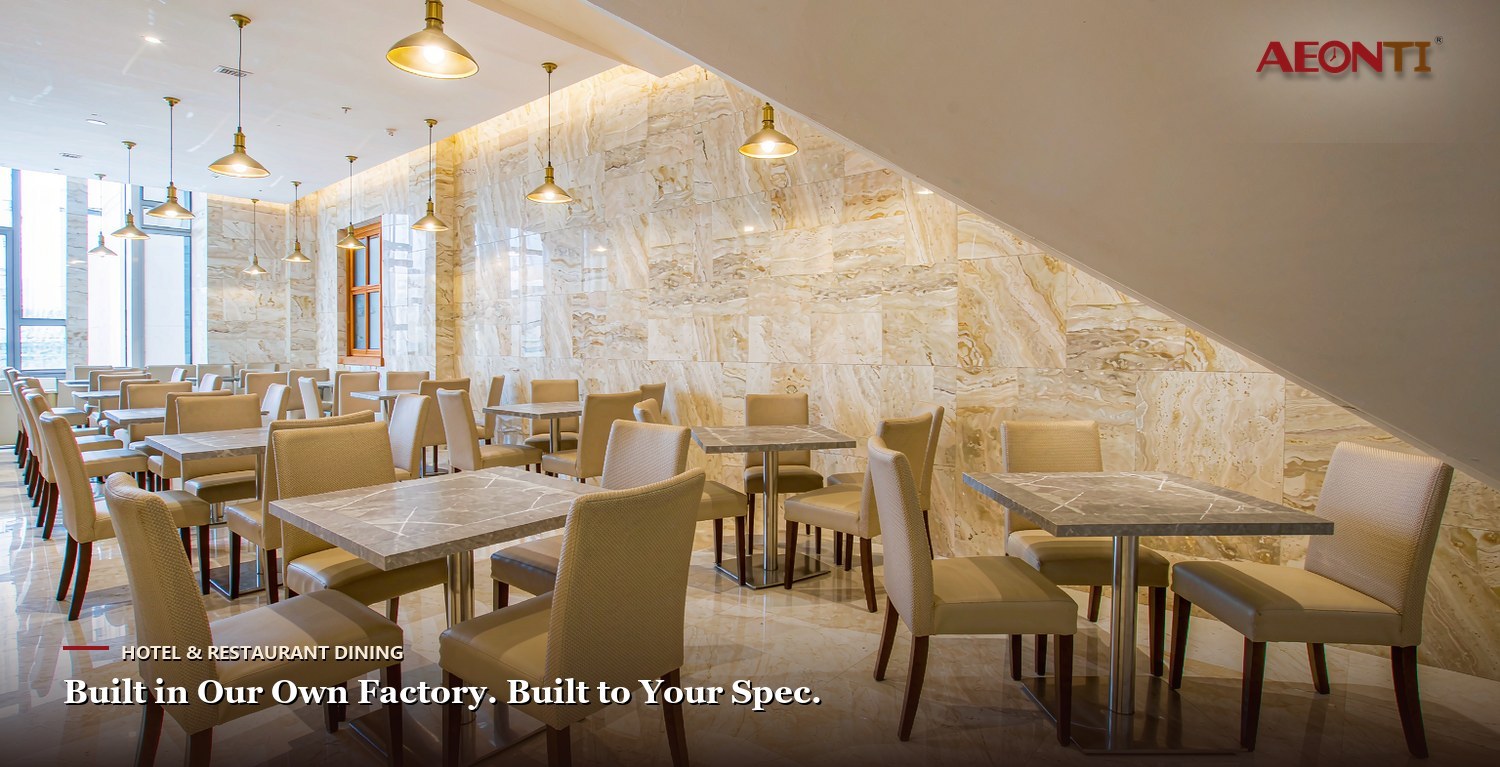
TABLE BASE TEST LAB · BUYING GUIDE
The Five-Tabletop Test: One Base, Five Tops
Five tabletops. One base architecture. Here is what really decides compatibility — and why it matters more to your SKU count than to your catalogue photography.
- 5 tabletop materials
- 1 base architecture
- 25 to 5 SKU combinations
- MOQ from 100 sets
The short answer
Yes — one properly engineered table base design can carry five very different tabletops: solid wood, sintered stone, artificial marble, HPL and custom commercial tops.
But compatibility is not decided by the tabletop. It is decided by the base underneath it: the mounting plate pattern, the floor plate footprint, the column section, the weld quality and the finish system. Get those five right and one product becomes five. Get them wrong and you own five separate structures that never share a purchase order.
In this guide
The purchasing logic
Why a table base should outlive the tabletop
Most buyers open with the wrong question. Not "what tabletop does this base fit?" but "can one base carry every tabletop my market asks for?"
The traditional way to build a range is one structure per tabletop. Wood tops get one base, sintered stone gets another, artificial marble gets a third, HPL a fourth, and every custom top starts a new development project. The catalogue looks rich. The operation behind it does not.
For restaurant furniture wholesalers, distributors, hotel project buyers and commercial furniture brands, that model produces more SKUs, more stock lines, more supplier threads and slower quotations for every single enquiry.
One base per tabletop
- 5 tops, 5 structural designs
- 5 sets of drawings and tooling
- 5 stock lines to forecast
- Slow re-quote on every new size
One base, five tops
- 5 tops, 1 structural platform
- 1 mounting plate logic, adjustable
- 1 stock line, 5 finished products
- Instant re-quote on new sizes
Reference table
One base family, five tabletop pairings
The pairing logic we use on commercial projects — tabletop weight first, then venue, then finish.
| Tabletop | Weight band | Recommended base line | Why it works |
|---|---|---|---|
| Solid wood / veneer | Medium | Iron table bases or stainless steel table bases | Warm material, easy cleaning underneath, forgiving on screw spacing |
| Sintered stone 12–20 mm | Heavy | Iron or cast iron table bases | Rigid support across the full panel, no flex at the mounting plate |
| Artificial marble | Very heavy | Cast iron or heavy-duty iron | Low centre of gravity, resistance to wobble on stone floors |
| HPL / compact laminate | Medium | Iron stamping table bases | One-piece moulded base, high volume, consistent batch to batch |
| Glass | Light | Stainless steel or aluminum table bases | Slim profile that does not fight the transparency of the top |
| Custom / outdoor tops | Varies | Custom table bases | Rust-proof finish, drainage-friendly plates, project-specific geometry |
Test 01
Solid wood: the easiest top, and the one most often under-specified
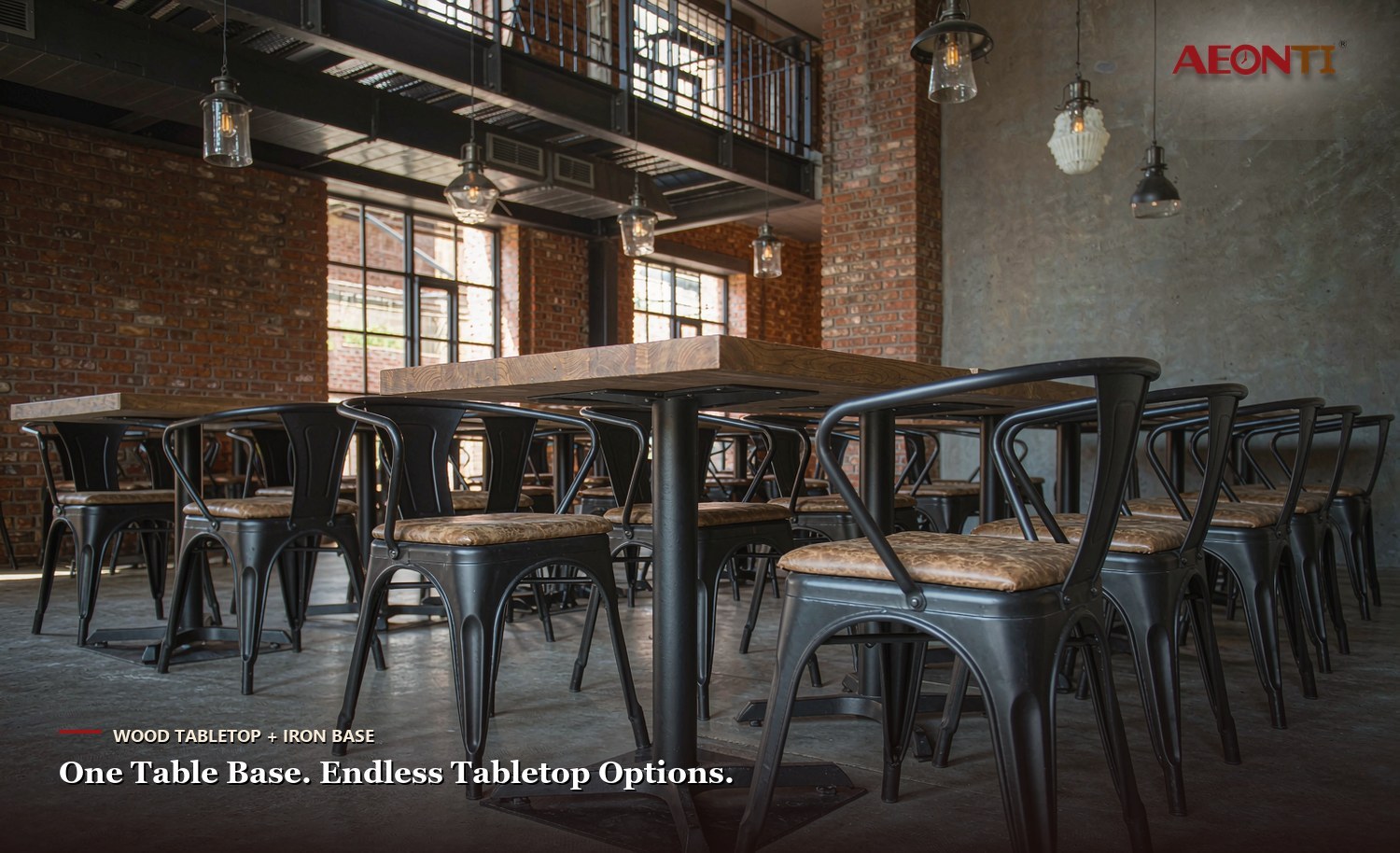
Wood is still the default choice for restaurants, cafes, hotels and mixed commercial spaces. It reads warm, it accepts almost any interior language, and it can be stained, lacquered or veneered to match a brand book.
Pairing it with a stable metal commercial table base is straightforward: a black powder-coated iron base with a wood top gives you the industrial-modern restaurant look instantly, without a new structural development.
- Check that the mounting plate screw spacing clears the frame of the top
- Allow for seasonal movement in solid timber tops
- Confirm levelling adjustment before the top is fixed
Test 02
Sintered stone: where the base stops being a design decision
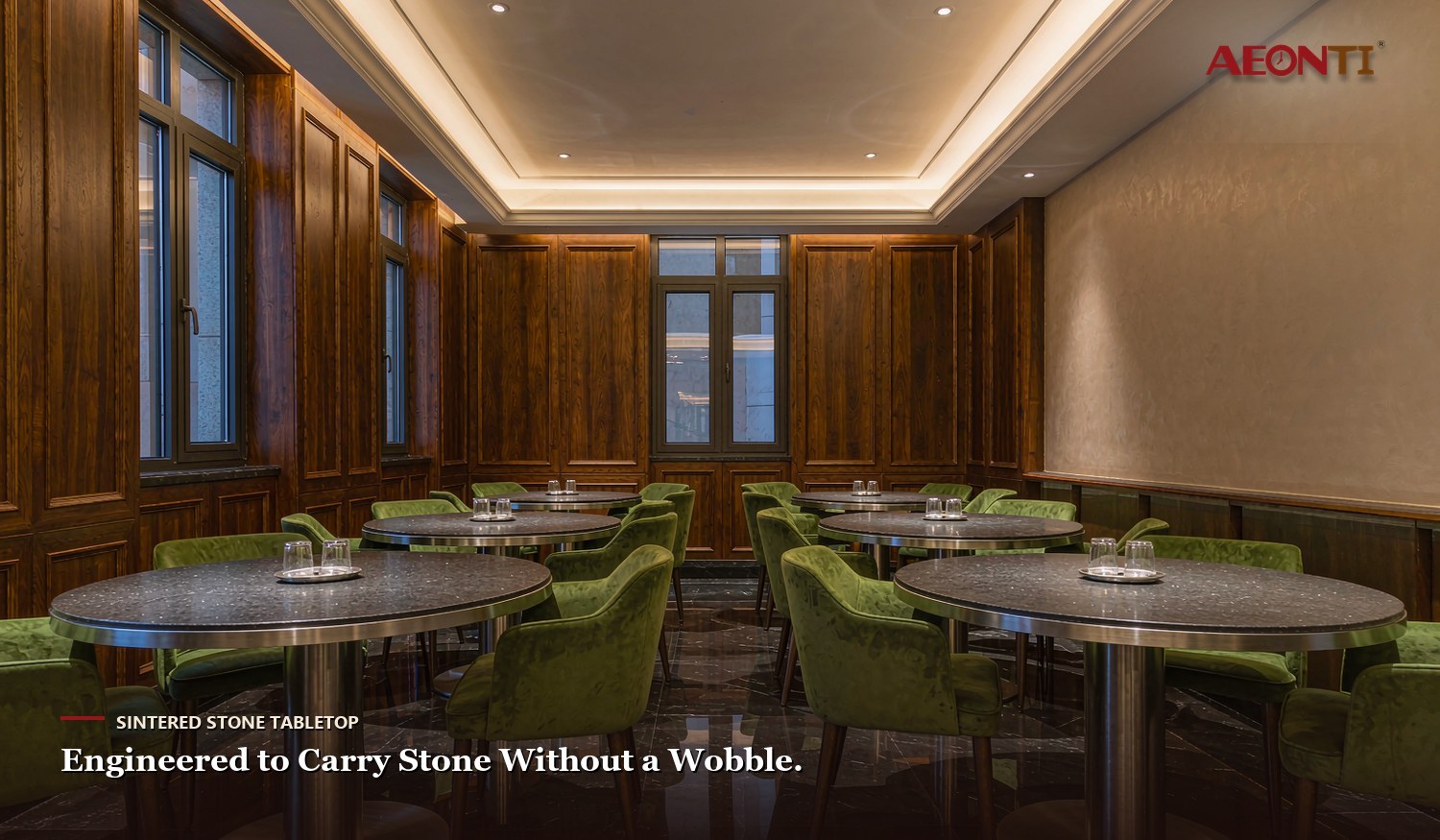
Sintered stone has moved from premium kitchens into hotel restaurants and chain dining rooms. It is scratch resistant, heat resistant, easy to wipe down and available in convincing stone and concrete textures.
It is also heavy and rigid. That pushes the whole question onto the base. The conversation that matters is not "does this base look right under stone" but "does this base hold that panel flat for eight years of service".
On a heavy-duty stainless steel table base, that means a mounting plate thick enough not to dish, a column section sized for the panel span, and a floor plate wide enough for the room's foot traffic.
Panel size and weight
Mounting plate and fixing pattern
Column section and floor plate
Use scenario and cleaning routine
The four-variable check we run before quoting any stone project — skipping one is how wobble starts.
Test 03
Artificial marble: same base, three completely different products
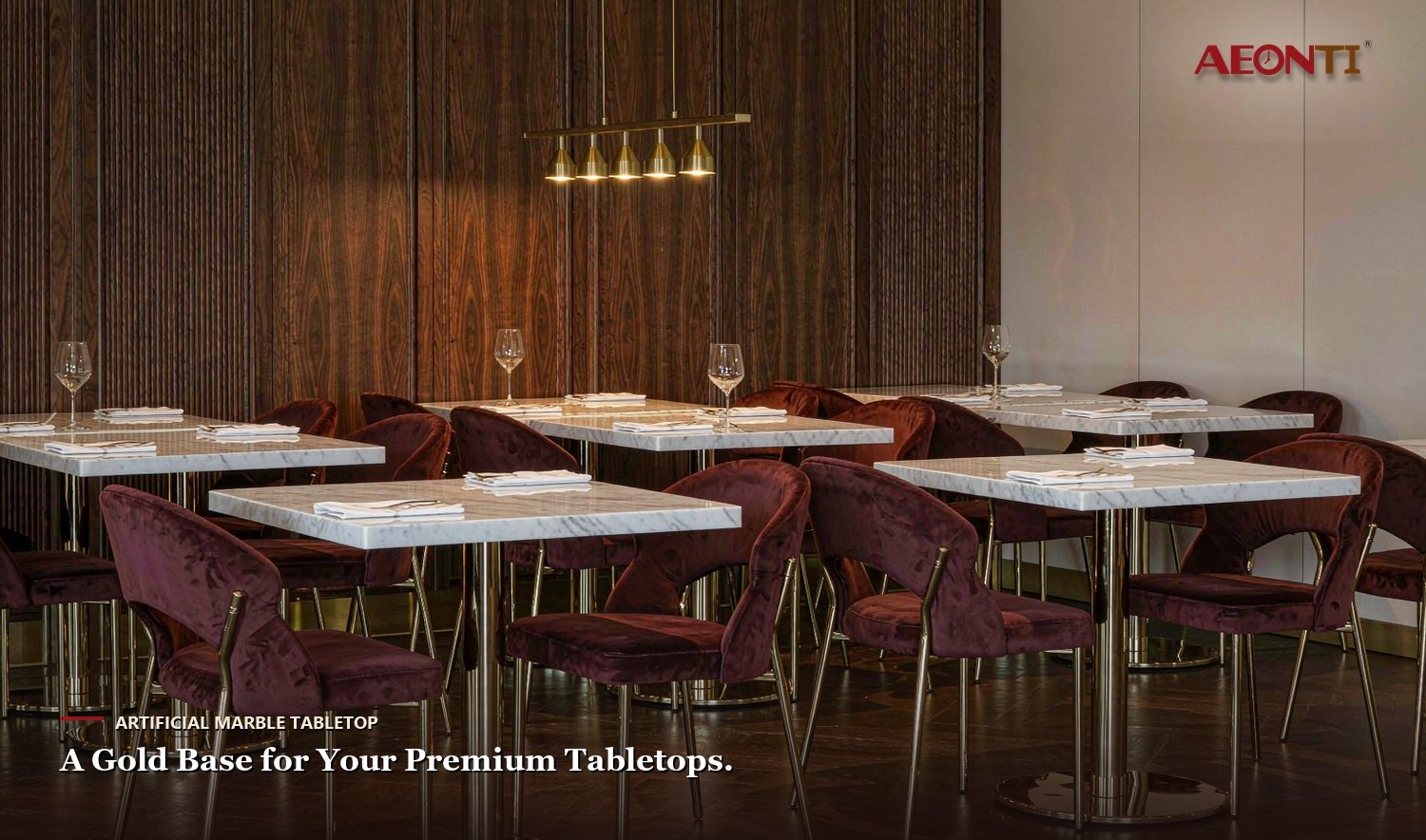
Artificial marble gives you the visual weight of stone with more control over colour, veining and format. It is also the fastest way to prove the modular argument, because the base does not have to change when the styling does.
Black base + white marble
Fine dining, brass accents, dark timber joinery
Black base + grey stone
Modern restaurant, concrete floors, low-key lighting
Gold base + light top
Hotel lounge, cafe, boutique commercial space
Base structure unchanged. Only the finish system and the top changed.
Test 04
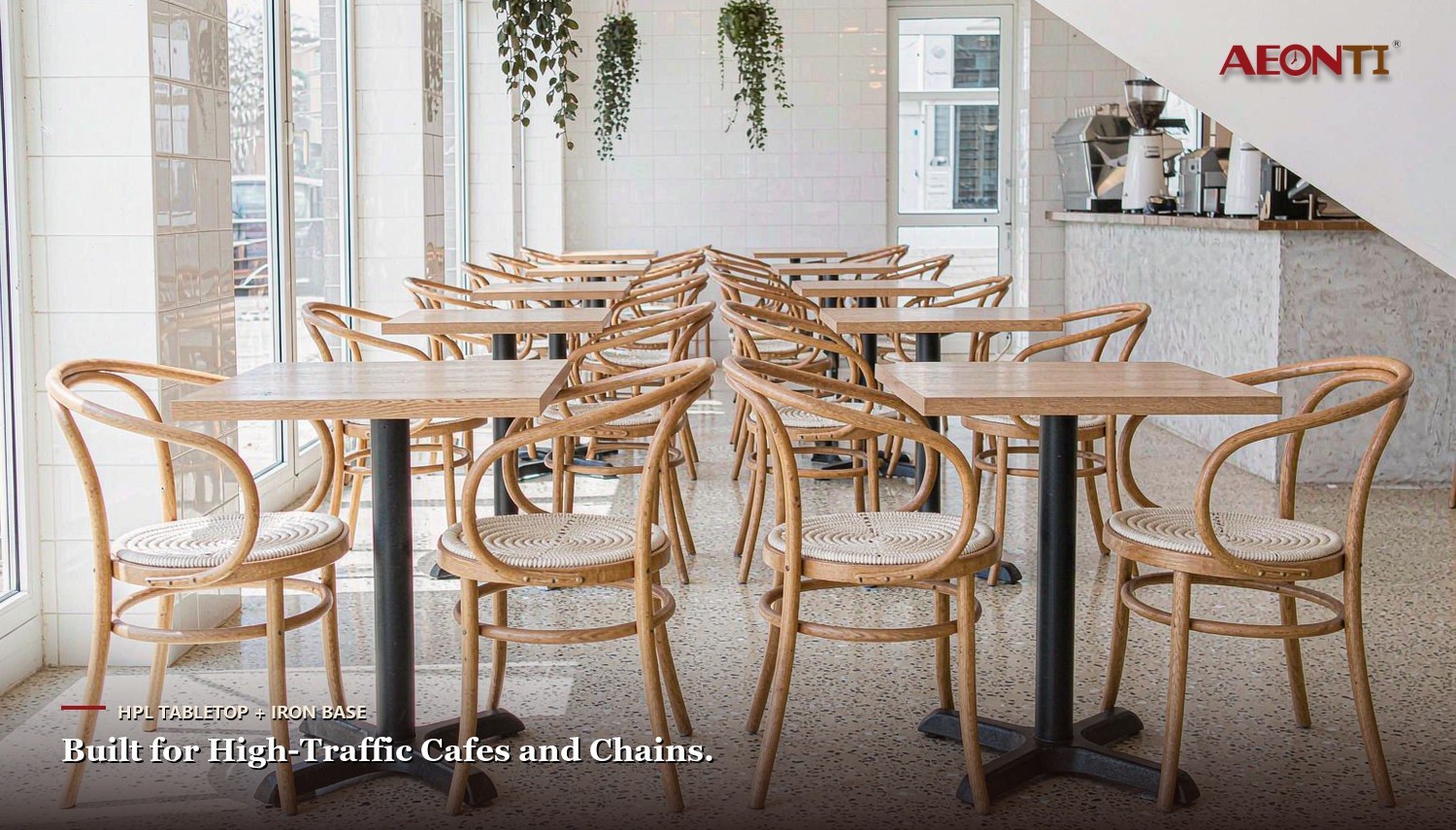
HPL: the volume play for chains and fast-casual
If your customers are chain restaurants, coffee shops, quick-service outlets or contract furniture projects, HPL is the material your order book will be built on. Wide colour range, credible patterns, easy daily maintenance and reliable batch consistency.
For a wholesale iron table base programme, HPL is where standardisation pays off most: one base, three laminate families, three product lines that all ship on the same purchase order.
Test 05
Custom and other commercial tops: the OEM case
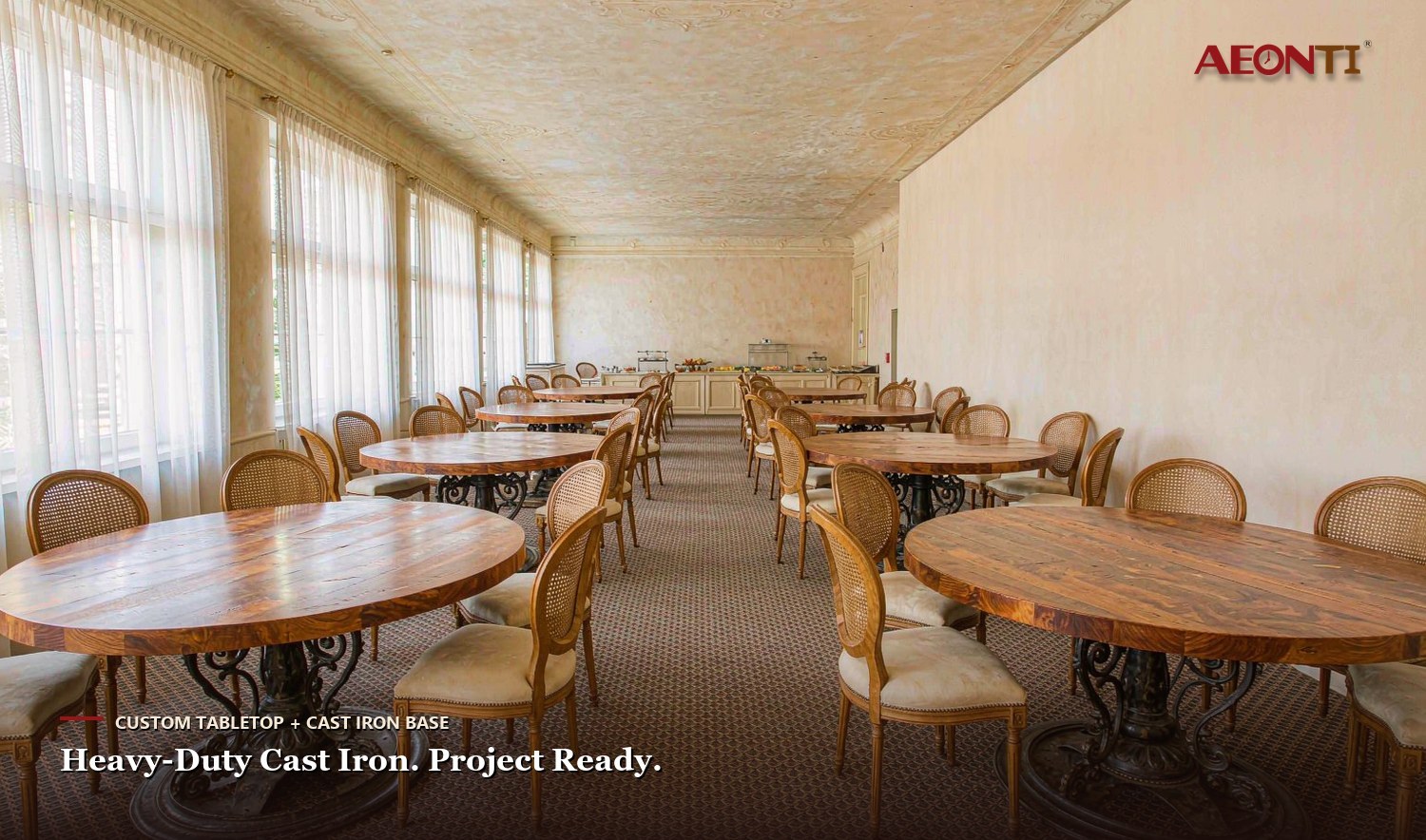
Custom board, composite panels, reclaimed timber, branded solid-surface tops — this is the category that decides whether a manufacturer is a supplier or a development partner.
Furniture brands rarely want the identical product that is already on the market. They want their own top, their own proportions, their own finish story, sitting on a structure that is already proven.
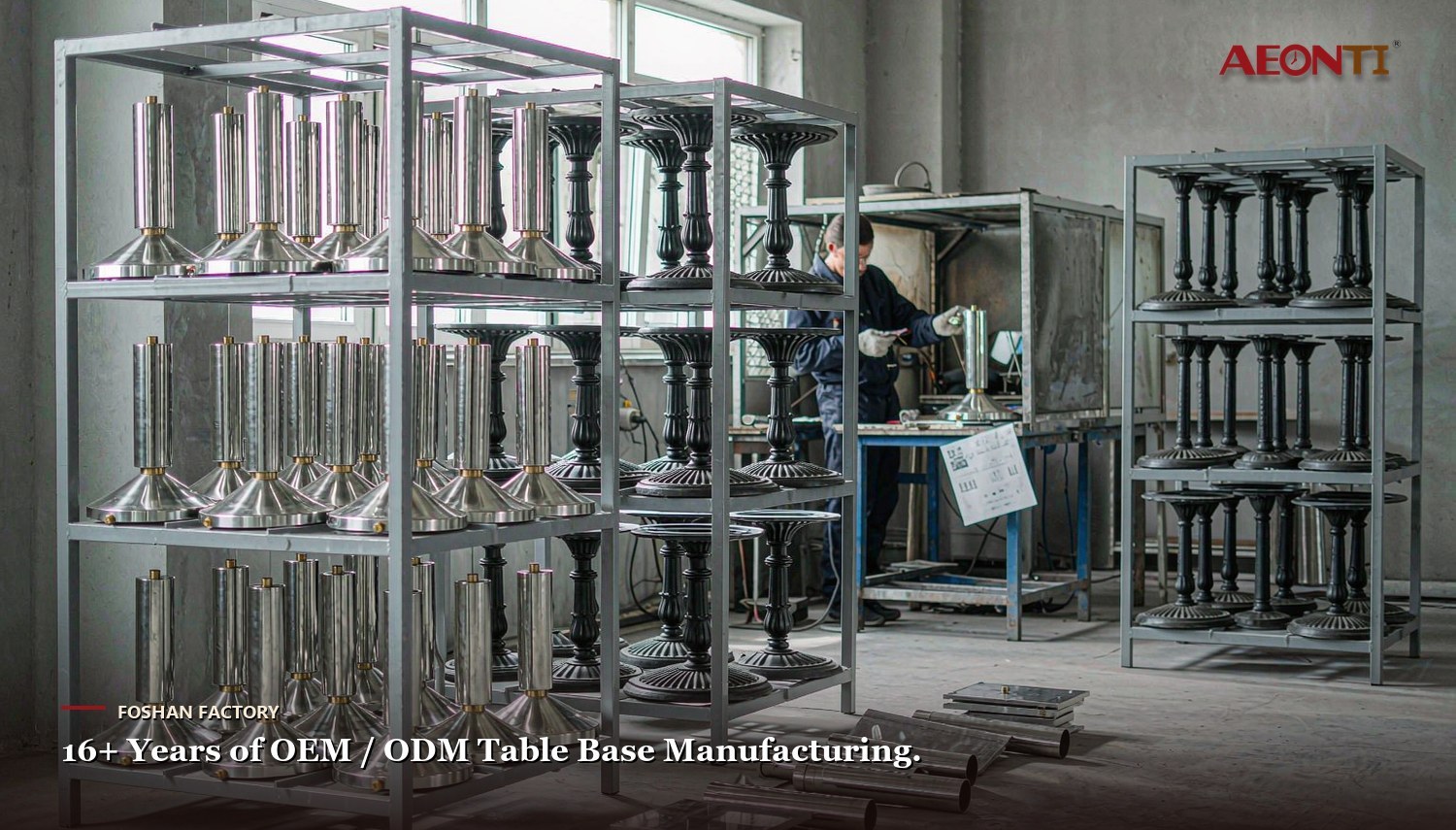
That is where OEM / ODM table base development matters: the buyer supplies the design intent, the manufacturer supplies the engineering, the tooling logic and the batch consistency.
Engineering
What actually decides compatibility — and it is not the tabletop
Swap the top and the base stays. That only works when four things were designed for flexibility from the start.
Mounting plate design
Slotted or multi-pattern holes so one plate accepts several fixing layouts. Adjustability is cheaper than a second SKU.
Floor plate and stability
Top size, top weight, base footprint and venue traffic have to be matched together — a bigger top is not solved by more screws.
Tube section and material
Stainless steel, aluminum, iron and cast iron trade strength against weight, appearance and cost. The right answer depends on the project.
Finish system
Powder coating, brushed, polished, electroplated or custom colour. One structure can become several product families on finish alone.
Commercial impact
The SKU math that convinces a finance director
A wholesaler buying five tops and five bases carries twenty-five combinations. Standardise part of the base range and the same market coverage needs five.
25
combinations
5 tops × 5 bases
5
combinations
5 tops × 1 base family
| Buyer type | What a modular base actually buys them |
|---|---|
| Furniture wholesalers | Fewer stock lines to forecast, faster quotations, one container can mix finishes instead of structures |
| Furniture distributors | Local market variants without local tooling investment |
| Restaurant and cafe chains | Identical understructure across brand concepts, different tops per format |
| Project contractors | Late design changes absorbed by a finishing change, not a re-engineering cycle |
| Commercial furniture brands | Own design language on proven engineering, with OEM / ODM support |
Before you place the order
Five questions to send your table base manufacturer
- 1
Which tabletop sizes can this base support?
A good answer is a range in millimetres, plus the rule behind it — not "any size".
- 2
Which tabletop materials has it been tested with?
Wood, sintered stone, artificial marble, HPL and glass should each come with a mounting recommendation.
- 3
What load capacity do you recommend per configuration?
Load rating follows top size, top weight, base footprint and venue use. Ask for it per configuration.
- 4
Can the mounting plate and fixing holes be customised?
This single answer determines whether one base can serve five tops in your range.
- 5
Do you support OEM / ODM for bulk orders?
If the answer is only "yes we can make it", you have found a workshop, not a development partner.
About the manufacturer
AEONTI builds the base, so your range can change the top
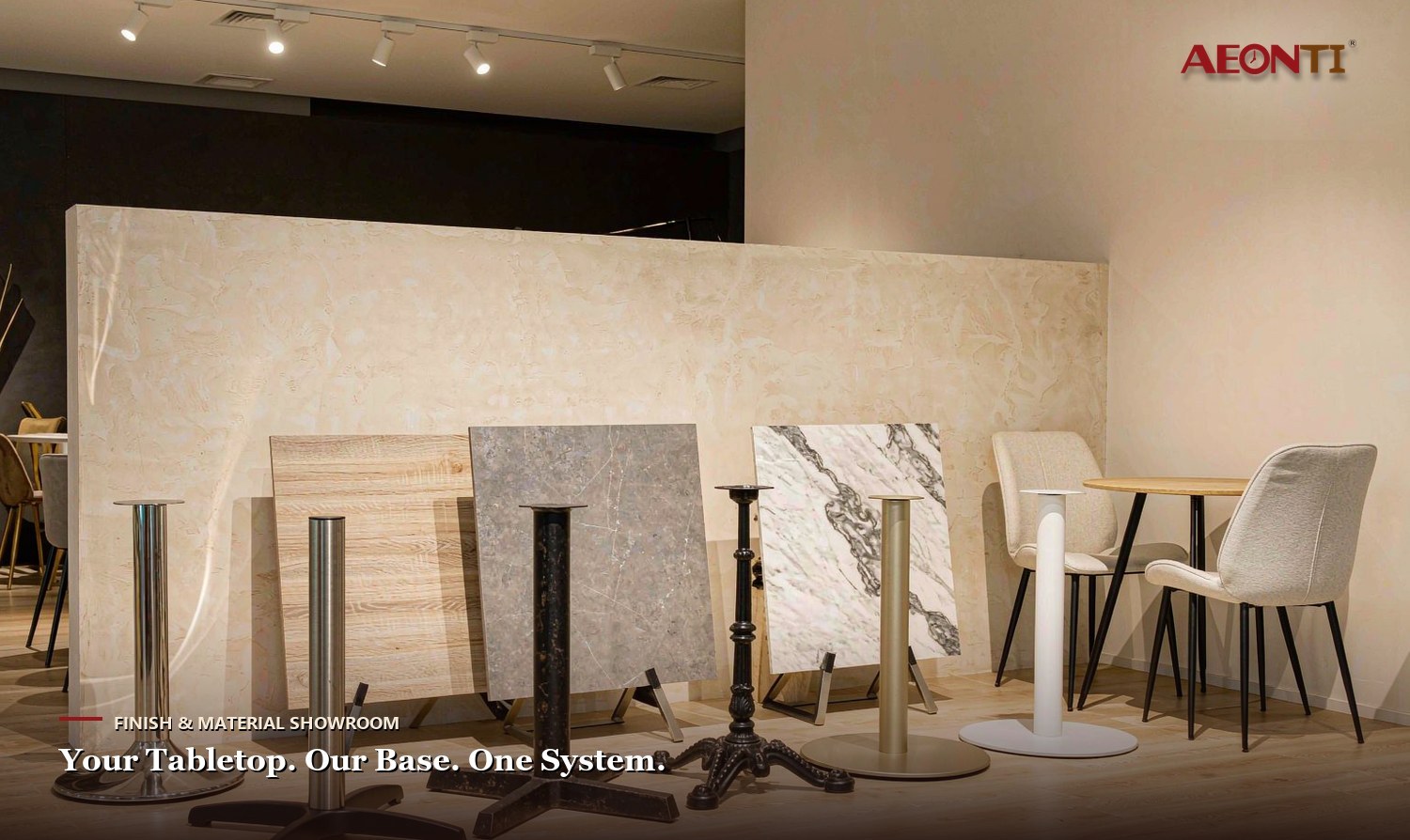
73 table base models across six material lines, produced in an 8,000 m² Foshan factory and shipped to 60+ countries. What buyers usually need is not one more model — it is one base that behaves well under five different tops.
The same programme covers the rest of the set: commercial table tops, complete commercial tables and dining chairs, so a hotel or restaurant project can be quoted, sampled and shipped as one package.
Next step
Send us your tabletop. We will spec the base around it.
Tell us the top size, the material, the quantity and where the tables will be used. You get a structural recommendation, a finish proposal and a bulk price — usually within one working day.
Get a bulk quote
Send your tabletop specification and target quantity. We reply with base options, finishes and a landed-cost estimate.
Request a quotationBuild the set online
Choose a base, a top and a chair, and preview the combination in 3D before you commit to a sample.
Open the 3D configuratorOrder a sample first
Test the stability, the finish and the mounting plate in your own space before the bulk order is released.
Ask for a sampleWhat to put in your first message
- Tabletop material and thickness
- Tabletop sizes and shapes
- Quantity per size, and project timeline
- Venue type: restaurant, hotel, cafe, outdoor
One table base. Multiple tabletop possibilities. Tell us your tabletop — we will build the right base for it.