Commercial Metal Dining Chairs Wholesale: How to Specify and Source Stackable Chairs for Restaurants and Hotels
- Share
- publisher
- Zoey
- Issue Time
- Sep 14,2026
Summary
This guide is written for restaurant chains, hotel procurement teams, project contractors, and furniture distributors who buy commercial metal dining chairs in volume. It covers the engineering details that separate a chair that survives five years of service from one that survives twelve months: frame tube specifications, welding method, coating thickness, stacking mechanics, ergonomic dimensions, and the total cost of ownership calculation that most purchase orders never run.
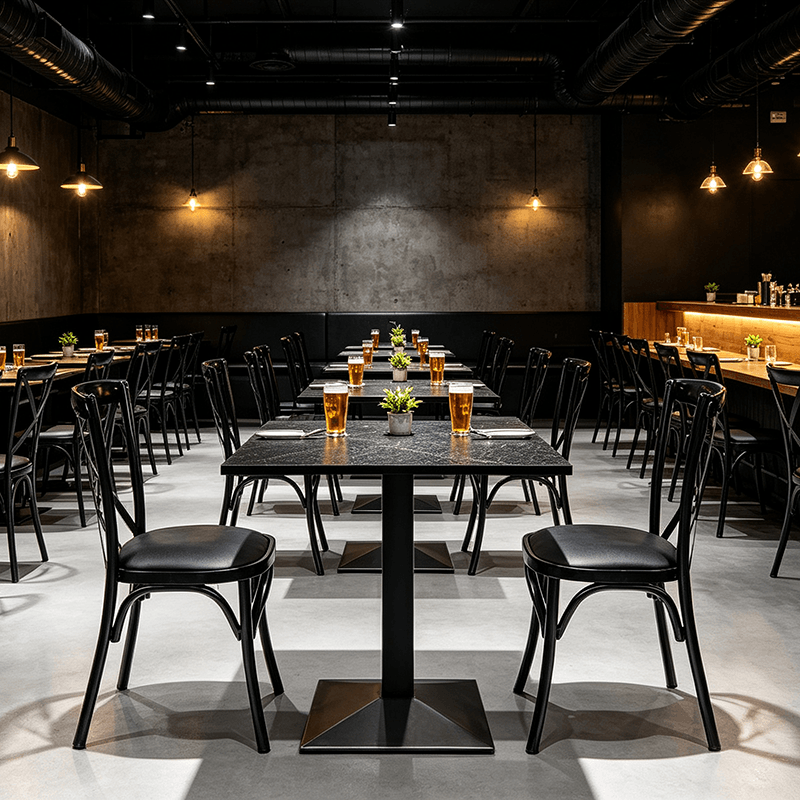
Most restaurant chairs are not replaced because they broke. They are replaced because the powder coating wore through at the stacking contact points, the welds at the rear leg joint started to flex, or the seat frame loosened after two years of being dragged across a tiled floor. By then the buyer has already paid for the chairs once — and is about to pay for them a second time.
This guide is written for restaurant chains, hotel procurement teams, project contractors, and furniture distributors who buy commercial metal dining chairs in volume. It covers the engineering details that separate a chair that survives five years of service from one that survives twelve months: frame tube specifications, welding method, coating thickness, stacking mechanics, ergonomic dimensions, container loading math, and the total cost of ownership calculation that most purchase orders never run. It closes with a specification template you can send directly to suppliers.
1. Why Metal Frames Dominate Commercial Dining Rooms
Look at the seating in any high-turnover restaurant and you will find a metal frame. Not because metal is the most beautiful material — upholstered timber chairs still win in fine dining — but because metal solves the three problems that commercial operators actually have.
1.1 The three operational problems metal solves
Handling abuse. A chair in a 200-cover restaurant is moved an estimated 20 to 40 times per day: pulled out, pushed in, shifted to accommodate a party of six, stacked at close, unstacked at open. Steel tolerates that cycle. Timber joints do not — mortise-and-tenon joints loosen, glue lines fail, and a chair that wobbles gets pulled out of service.
Cleaning speed. Powder-coated steel and molded plastic surfaces can be wiped down in seconds. Fabric seats need vacuuming, spot treatment and periodic deep cleaning. In a venue with a 45-minute average table turn, cleaning speed directly affects covers per service.
Storage density. Floor space in a city-centre restaurant is the single most expensive asset in the business. Stackable metal chairs can be consolidated into a corner at close, converting 40 m² of dining floor back into circulation space overnight.
1.2 What "commercial grade" means in practice
"Commercial grade" is not a regulated term. Any supplier can print it on a spec sheet. What it actually describes is a set of construction decisions that cost more to build and are invisible in a product photo. The table below is a practical translation.
| Component | Household / light-duty | Commercial grade | |
| Frame tube wall thickness | 0.8 – 1.0 mm | 1.2 – 1.5 mm | |
| Tube diameter (main frame) | 19 – 22 mm | 25 – 38 mm | |
| Joint method | Spot weld, 2 – 4 points | Continuous or multi-pass weld | |
Powder coating film | 40 – 60 μm, minimal pre-treatment | 70 – 120 μm, full chemical pre-treatment | |
Seat substrate | Single-ply board | Multi-ply board, pressed steel, or molded foam | |
Floor glide | Bare steel or thin plastic cap | Replaceable nylon or felt glide | |
The gap between the two columns is often a 15 to 30 percent difference in unit price — and roughly a three to five times difference in service life. That is the entire argument for specification-driven purchasing.
2. The Anatomy of a Commercial Metal Dining Chair
Six components determine how a metal chair performs. Each one is a line item you can specify, verify and hold a supplier to.
2.1 Frame tube: diameter and wall thickness
Two chairs can look identical in a catalogue photo and differ by 40 percent in steel weight. The difference lives in the wall thickness, which is invisible once the frame is powder coated.
For commercial dining use, a main frame tube of 25 mm to 38 mm diameter with 1.2 mm to 1.5 mm wall thickness is the working range for steel frames. Below 1.0 mm, the tube dents on impact and flexes under load; above 2.0 mm, the chair becomes unnecessarily heavy and adds freight cost for no structural gain.
Two verification methods that do not require destroying a sample: weigh the chair against the supplier's stated weight (a 15 percent shortfall usually means thinner tube than quoted), and ask for the tube wall thickness on the mill certificate. A supplier who cannot produce either is working from an assumption, not a specification.
2.2 Welding: full weld versus spot weld
This is the single most common point of early failure. Spot welding — three or four tacks at a joint — is fast and cheap. Under the repeated lateral loading of a person leaning back in a chair, spot welds at the rear leg joint eventually develop hairline cracks, the joint flexes, and the chair develops the characteristic "wobble" that gets it pulled from the floor.
Ask directly: is the seat frame fully welded around the joint, and are the welds ground flush before coating? An unground weld is not only a durability question — it is a coating question, because powder cannot properly cover a sharp weld spatter edge, and that edge is where corrosion starts.
2.3 Powder coating: film thickness and pre-treatment
The coating is the only thing standing between the steel and the cleaning chemicals, food acids, and moisture of a working dining room. Film thickness is measured in micrometres (μm) and is the spec that matters most.
• Indoor commercial use: 70 – 100 μm over a properly pre-treated surface
• Outdoor or semi-outdoor: 90 – 120 μm, plus a phosphate or chromate pre-treatment stage
• Pre-treatment is not optional. Degrease alone is insufficient. A three-stage wash (degrease, rinse, phosphate) is what allows the powder to actually bond to the steel rather than sit on top of oil residue
The practical verification is a cross-hatch adhesion test on a production sample: score the coating in a grid, apply tape, pull. Coating that lifts with the tape was applied over an insufficiently prepared surface — and will fail in service regardless of the film thickness number on the spec sheet.
2.4 Seat and back construction
Four substrate options appear in commercial chairs. Each carries a real trade-off.
| Substrate | Best for | Watch out for | |
| Pressed / stamped steel | High-abuse, fast-clean venues; outdoor terraces | Cold to sit on without a cushion; risks denting if under-specified | |
| Molded plywood | Cafés, bistros; warmer look; wood finishes | Edge delamination if the seat edge is not sealed | |
| Molded foam over board | Long-dwell venues; comfort over 90 minutes | Foam density — below 30 kg/m³ the seat flattens within a year | |
Upholstered over foam | Hotels, fine dining, brand-led interiors | Fabric wear — ask for the Martindale rub count | |
For foam, the figure to request is density in kg/m³. Commercial seating generally needs 30 kg/m³ or above. Below that, the seat compresses permanently under daily use and the chair looks tired long before the frame fails.
2.5 Floor glides: the cheapest component that causes the most replacement
A nylon or felt glide costs a few cents. When it wears through, bare steel contacts a tiled or timber floor and starts scratching it — and the operator, not the supplier, pays for the floor repair. Specify replaceable glides and ask what the replacement part costs and whether it is a standard commercial size. A glide that can be swapped in seconds extends the chair's usable life by years at negligible cost.
3. Styles, Finishes and Where Each One Belongs
Metal dining chair styles are not interchangeable. Each was developed for a specific operating environment, and using one outside its intended context creates a predictable failure.
3.1 Tolix and bistro style
The French café classic: stamped steel seat and back, slender tubular legs, usually in a single powder-coated colour. Lightweight, stackable, extremely durable, and visually neutral. Best fit for cafés, casual dining, and high-turnover venues where speed of service matters more than comfort over a long sitting.
3.2 Cross-back and industrial style
A steel frame with a crossed backrest, often paired with a timber or composite seat. Reads as "craft" or "industrial" and photographs well. Best fit for breweries, gastropubs, and design-led casual concepts. The cross-back adds a structural node that must be fully welded — this is where the welding question from 2.2 matters most.
3.3 Modern minimalist tube frame
Round or square tube, clean geometry, minimal ornament, frequently in matte black or brushed finishes. The most versatile style for volume projects because it integrates with almost any interior scheme. Best fit for chain rollouts, where a single chair model has to work across locations with different interior designs.
3.4 Wood-grain transfer finish on metal
A sublimation process transfers a wood-grain pattern onto a powder-coated metal substrate. The result reads as timber at conversational distance while carrying metal's structural durability — and typically at a lower unit cost than solid timber. Best fit for operators who want a warm interior but cannot accept timber's maintenance and replacement cycle. Ask about UV stability if the chair will sit near windows, since some transfer films fade faster than the base coating.
3.5 Bar and counter height variants
The same frame design is usually offered in a bar-height version with a footrest and a longer leg. Do not assume this is a simple leg-length change — the taller the frame, the more the lateral stability depends on the footrest acting as a structural brace. Confirm the footrest is welded into the frame rather than bolted on.
4. Stackability: What Actually Matters
Every supplier quotes a stack height. Very few buyers ask the right follow-up questions.
4.1 Stack height is a marketing number; stability is the specification
"Stacks 10 high" describes the theoretical maximum in a showroom with a perfectly level floor. In a working back-of-house, chairs are stacked quickly, on uneven surfaces, by staff who are in a hurry. The number that matters is the height at which the stack remains stable under a light lateral nudge.
For most commercial metal chairs, a usable stack of 6 to 8 units is realistic. Above that, the stack becomes top-heavy and requires two people to move safely. When a supplier quotes 12 or 15, ask what the tested stable height is, not the maximum.
4.2 Contact point protection
Every time chairs are stacked, the frame of one chair contacts the frame or seat of the next. Those contact points are where powder coating wears through first — and once the coating is breached, corrosion begins at that spot.
Three design details protect against this, and all three are worth confirming:
• Contact points positioned on flat, coated surfaces rather than on weld beads or edges
• Protective elements — a plastic insert, a felt pad, or a rubber stop at the contact point
• Non-contact stacking geometry, where the chair above rests on the chair below without frame-on-frame contact at all
Chairs that stack frame-on-frame with no protection will show coating wear at the contact points within 6 to 12 months in daily use. That wear is cosmetic at first and structural later.
4.3 Trolley compatibility
For banquet halls, event venues and large hotels, chairs are not carried — they are moved on trolleys. Trolley compatibility depends on the chair's footprint matching a standard dolly channel. If the venue plans to use trolleys, the chair footprint dimension needs to be confirmed against the trolley supplier's specification before the order is placed, not after the container arrives.
5. Seat Height, Table Height and the Ergonomics Buyers Forget to Check
A chair that is the wrong height for its table is uncomfortable no matter how well it is built — and the error is usually only discovered when the furniture is already installed. The three standard height relationships are fixed by convention and should be treated as hard constraints.
| Setting | Seat height | Table height | Used for |
| Standard dining | 45 – 47 cm | 75 cm | Restaurants, cafés, hotel breakfast rooms |
| Counter height | 61 – 66 cm | 90 cm | Café counter seating, casual bar areas |
| Bar height | 71 – 76 cm | 105 cm | Bars, high-top poseur tables |
The working rule is a 25 to 30 cm clearance between the seat surface and the underside of the table top. Less than that and diners cannot cross their legs; more than that and the table feels distant and awkward.
5.1 Seat depth and backrest angle
Two further dimensions shape comfort over a full sitting. Seat depth of 40 to 45 cm suits most adult diners; deeper than 46 cm and shorter guests cannot use the backrest at all. Backrest angle of roughly 100 to 105 degrees from horizontal is the range that supports a 60 to 90 minute meal without encouraging slouching. Steeper, more upright backs look formal but become uncomfortable within half an hour.
5.2 Where ergonomics and stackability conflict
These two requirements pull in opposite directions: a chair that stacks tightly needs a compact, near-vertical geometry, while a chair that is comfortable over a long meal needs a reclined back and a deeper seat. This is a genuine trade-off, and it should be resolved at the brief stage — a fine-dining venue with 2-hour average dwell time should prioritise ergonomics and accept a lower stack; a fast-casual venue with 30-minute turns should prioritise stackability.t
6. Indoor versus Outdoor Specification
An outdoor chair is not an indoor chair left outside. Four things change, and all four are specification lines rather than product names.
6.1 Coating system
Outdoor exposure means UV radiation, rain, temperature cycling and, in coastal locations, airborne chloride. The coating system needs a higher film thickness (90 – 120 μm) and, critically, a surface pre-treatment stage suited to the exposure. For coastal projects, a salt-spray resistance test result is the number to request from the supplier — the common benchmarks are 48 hours, 240 hours and 500 hours, and the appropriate target depends on how close the venue is to the sea.
6.2 Hardware and fasteners
Any bolt, screw or rivet in the chair should be stainless or otherwise corrosion-protected. This is the most frequently overlooked line in an outdoor specification: the frame survives but the fasteners rust, stain the coating, and eventually fail.
6.3 Seat material behaviour under UV
Plastic and composite seats need UV stabilisation. Without it, polypropylene seats chalk, fade and become brittle within two to three summers. Ask whether the seat material is UV-stabilised and, for coloured products, whether the pigment is UV-stable or surface-applied.
6.4 Drainage and water traps
Any tubular frame with an open end will collect water, which then freezes, expands and splits the tube — or simply rusts from the inside out. Sealed tube ends and drainage paths are a small design detail with a disproportionate effect on outdoor service life.
7. Container Loading: The Math That Changes Your Landed Cost
Freight is a large share of the landed cost of chairs, and the difference between a well-packed and a poorly-packed order can be 30 percent or more of the total. This calculation is worth running before the purchase order, not after.
7.1 Stacked versus knock-down
Stackable chairs ship stacked, which is already efficient. For chairs that do not stack — upholstered armchairs, fixed-frame designs — a knock-down (KD) construction, where the legs or base ship detached and are assembled on arrival, can improve container utilisation substantially. The trade-off is assembly labour at destination and the risk of missing hardware, so KD suits large projects with on-site assembly teams rather than small distributors.
7.2 Working container figures
Using a common commercial metal chair at roughly 45 × 50 × 85 cm, with a realistic stack of 8 to 10 units per stack and allowance for packaging:
| Container | Usable volume | Indicative chair quantity | |
| 20 GP | ≈ 28 CBM | ≈ 380 – 450 | |
| 40 GP | ≈ 58 CBM | ≈ 780 – 900 | |
| 40 HQ | ≈ 68 CBM | ≈ 900 – 1,150 | |
These are planning figures, not quotations. The real number depends on the specific chair's footprint, the actual stack geometry, whether pallets are used, and how much void fill the packaging requires. Ask the supplier for the packing rate per carton and per container for the exact model quoted — a supplier who quotes a price without a packing rate is not giving you a landed cost.
7.3 The mixed container strategy
An order of 300 chairs does not need a full container. A mixed load — chairs plus table tops, or chairs plus table bases, or two chair models — fills the container and reduces per-unit freight. This matters most for smaller importers and for project orders where the furniture package includes multiple product categories. Confirm with the supplier whether mixed containers are accepted and how the order is consolidated, since not all factories will co-load across product lines.
8. Total Cost of Ownership Over Five Years
Unit price comparison is the standard purchasing method and the standard purchasing mistake. The calculation that matters is cost per usable chair-year.
8.1 The comparison, worked through
Consider two chairs bought at 100 units each for a 100-seat restaurant.
| Line item | Economy chair | Commercial-grade chair | |
| Unit price | Index 100 | Index 125 | |
| Expected service life | 2 – 3 years | 8 – 12 years | |
| Replacement cycles over 5 years | 1 – 2 | 0 | |
Early failure rate per year | 8 – 12% of units | 1 – 3% of units | |
Freight per replacement batch | Small volume, poor rate | Not applicable | |
Staff time on swaps and wobble reports | Recurring | Minimal | |
Across five years, the economy chair is typically replaced once or twice, and each replacement carries freight, duty, labour and procurement overhead far higher per unit than the original order because the volume is smaller. The commercial-grade chair costs 25 percent more at the outset and finishes the five-year period at a lower total — usually by a wide margin, and before any allowance for guest experience or brand consistency.
8.2 The hidden cost that never appears in a quotation
Every mismatched replacement chair is visible to guests. A dining room where 12 of 100 chairs are a slightly different shade, or a slightly different model, looks neglected — and that impression carries into how guests judge the entire operation. Consistency of supply over the chair's life matters as much as the chair's build, which is why spare parts availability and the supplier's willingness to hold a production batch for future reorders belongs in the evaluation.
9. Building a Specification That Gets an Accurate Quote
Most slow or inaccurate quotations are not the supplier's fault. They are the result of an incomplete brief. The specification below takes a few minutes to complete and removes the ambiguity that causes re-quoted prices, changed delivery dates and specification disputes.
9.1 The twelve-line metal chair specification
1. Style reference — a model name, a photo, or a sketch; state whether it must match an existing design exactly
2. Quantity — total units, and the split by model or colour if more than one
3. Application — indoor, covered outdoor, or fully exposed; approximate daily service hours
4. Frame material — steel, aluminium (for weight-sensitive outdoor projects), or supplier recommendation
5. Finish — powder coat colour reference, gloss level, or wood-grain transfer
6. Seat and back material — pressed steel, molded plywood, foam density if upholstered, fabric rub count if fabric
7. Dimensions — overall height, seat height, seat width and depth, and the intended table height
8. Stacking requirement — required stable stack height and whether trolleys will be used
9. Loading requirement — target load rating, and whether third-party load testing is required
10. Branding — logo application method and placement, if any
11. Packaging — carton specification, palletisation, moisture protection, and mixed-container acceptance
12. Commercial terms — Incoterm, delivery destination, target date, and sample approval expectations
9.2 The sample approval step
For any order above a few hundred units, a pre-production sample is not an administrative formality — it is the document that defines acceptable quality for the whole order. The sample should be retained by both parties, and the inspection criteria for the production run should be written against it. Confirm that sample cost and sample lead time are stated separately in the quotation, and clarify whether sample cost is credited against the bulk order.
10. Frequently Asked Questions
10.1 What is the standard MOQ for wholesale metal dining chairs?
Minimum order quantities vary widely, from 50 units for stock models to several hundred for fully custom designs, because custom orders require colour setup and production line changeover. Suppliers operating a factory-direct model typically set MOQ at 100 sets per design for standard ranges, with mixed-container orders accepted for stock models.
10.2 How long does production take?
Standard production lead time for a commercial chair order typically runs 25 to 45 days after sample approval, depending on order volume and the degree of customisation. Sea transit time is separate and depends on the destination port and the schedule of the appointed forwarder.
10.3 Can I mix two or three chair models in one container?
Often yes, provided each model meets its own minimum quantity. Mixed loading improves container fill and reduces freight per unit, which matters most for orders below a full container. Confirm consolidation capability with the supplier in advance, since not every factory co-loads across product lines.
10.4 Should I specify a load rating for the chairs?
Yes. A common commercial benchmark is a static load rating in the region of 300 lb / 136 kg for general dining use, higher for venues with heavy usage. Where the destination market requires certified load testing, that testing is normally arranged with a third-party laboratory, and the supplier should be asked to confirm the chair's tested capacity as well as the applicable standard for the target market.
10.5 Do metal chairs scratch floors?
Not if the glides are maintained. Bare steel legs will mark timber and tile. Chairs fitted with replaceable nylon or felt glides protect the floor, and the glide is a consumable part that should be checked periodically and replaced. Ask for the glide replacement specification and cost as part of the order.
10.6 Are metal chairs suitable for outdoor terraces?
Yes, with the right specification: higher powder coating film thickness, corrosion-protected fasteners, sealed tube ends, and UV-stable seat materials. For coastal locations, ask for a salt-spray test result and confirm the finish system is appropriate for the exposure level. An indoor-specified chair will fail outdoors within a season or two.
11. About AEONTI
AEONTI is a commercial furniture manufacturer based in Foshan, China, operating an 8,000 m² production facility. We manufacture wholesale table bases, table tops, dining tables and dining chairs for importers, project contractors, restaurant operators and global brands, serving customers across North America, Europe, the Middle East and Australia.
Our dining chair range covers metal, upholstered, leather, plastic and outdoor seating, with the metal range built on the same in-house metalworking capability that produces our table bases — tube forming, welding, grinding and powder coating are carried out in-house rather than subcontracted, which is why the frame specification can be quoted and verified line by line rather than taken on trust.
Standard wholesale orders run at MOQ 100 sets with a 25–30 day production lead time. For projects that combine chairs with table bases or table tops, we support mixed-container loading so that a furniture package ships together rather than in separate shipments. Custom colour matching, logo application, private label packaging, and pre-production sampling are available across the range. We also offer an online customisation preview for buyers who need to see a configuration before committing to a sample.
On certification, we are direct: we do not present third-party certifications we do not hold. We carry out in-house performance testing for load, stability and finish consistency, and where a project requires certified testing against a specific market standard, we support third-party laboratory testing at the customer's cost. Buyers who need documentation should ask for exactly what they need, and we will tell you plainly what we can and cannot provide.
To request a quotation, send your chair style reference, quantity, application (indoor or outdoor), finish requirements, dimensions and target delivery date. For project orders, include the full furniture package — chairs, table bases and table tops — so that we can quote loading, packing and freight as a single plan.
📞 WhatsApp: +86 17841353079
📧 Email: aeonti@aeonti.com
🌐 Website: www.aeonti.com