Custom Table Bases for Sintered Stone & Wooden Table Tops – A Complete Specification Guide
- Share
- publisher
- Cinnia
- Issue Time
- Jul 21,2026
Summary
This is a buying guide for custom table bases for sintered stone and solid wood tops. It states support requirements for two tabletop materials, introduces features of carbon steel, stainless steel, aluminum alloy and cast iron bases, provides matching size ratios, answers common purchasing questions, and offers reference for catering furniture buyers on selection and customization quotation.
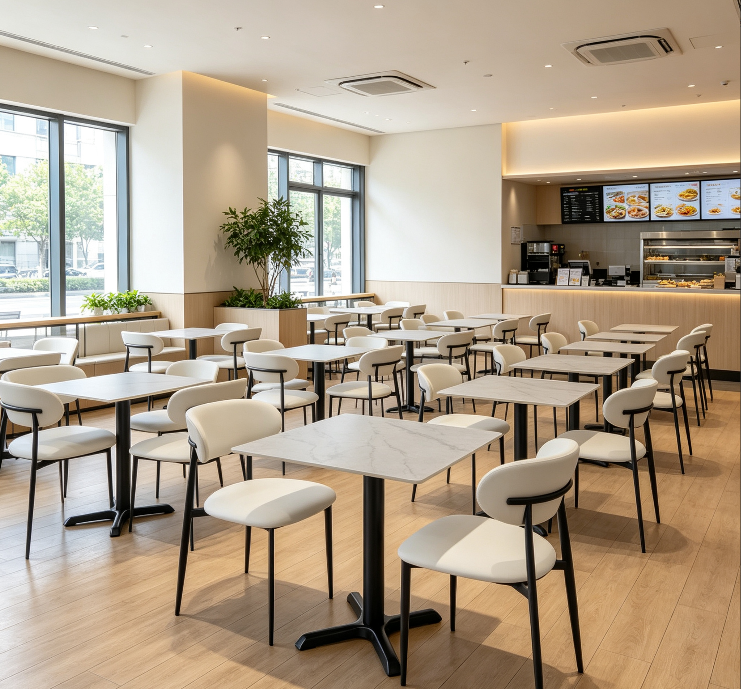
Introduction:Special Requirements for Sintered Stone & Wooden Tops
Sintered stone and solid wood represent two fundamentally different tabletop materials — one is a high-tech engineered surface with remarkable density and hardness, the other is a timeless natural material prized for warmth and character. Each demands a completely different approach to base selection and design. A mismatched base can lead to stone cracking, wood warping, wobbling instability, and premature structural failure. This guide covers every specification — from material compatibility to installation best practices — so you can order the right custom base with confidence.
Key Design Considerations for Sintered Stone Table Bases
Sintered stone is manufactured under extreme heat and pressure, mimicking the natural stone-forming process. The resulting surface is highly dense, non-porous, scratch-resistant, and UV-stable — yet brittle under concentrated stress, much like tempered glass.
Load-Bearing & Support Distribution
Unlike natural granite (which has some internal grain structure that absorbs micro-stress), sintered stone is homogeneous. A single point load — such as a bolt head bearing directly against the underside — can initiate a crack that propagates across the entire panel.
| Base Type | Max Safe Load | Support Style | Compatibility |
| Full-frame steel (perimeter support) | 200–350 kg | Continuous edge + cross-brace | Best for sintered stone |
| Wide pedestal (ø40 cm+ top plate) | 180–280 kg | Central plate + radial arms | Suitable for round tables ≤ 1.5 m |
| Cross-leg frame + top plate | 150–250 kg | 4-point support plate + frame | Acceptable with felt pads |
4-leg with individual pads | 100–180 kg | Isolated contact points | Not recommended — stress concentration risk |
Leveling Adjustment
Sintered stone slabs can be engineered flat, but no floor is perfectly level. A wobbling table concentrates stress at the low corner, and sintered stone has almost zero flex tolerance before fracturing.
Required leveling features:
Soft felt pads — absorb micro-vibrations transmitted to the stone
Minimum 20 mm adjustment range — sintered stone tolerates no rocking whatsoever
Key Design Considerations for Wooden Table Bases
Wood is a living material — it breathes and expands/contracts with seasonal humidity changes. A solid wood tabletop can expand by 3–8 mm across its width between dry winter and humid summer conditions. A base that rigidly clamps the wood in place will eventually cause splitting, cupping, or joint failure.
Center of Gravity & Stability
Wooden tops are lighter than stone, which means the base must provide proportionally more mass near the floor to prevent tipping. This is especially important for narrow tables or those placed on carpet.
Anti-Slip & Movement Accommodation
| Component | Purpose | Specification |
| Felt pads | Prevent squeaking between base frame and table legs | Thickness 1.5–1.7 mm |
| Ventilation gap | Prevent moisture trapping under the tabletop | 3–5 mm gap between frame and wood underside |
Recommended Base Materials for Sintered Stone Tops
Steel Bases — The Gold Standard
Steel is the dominant choice for sintered stone support. Its stiffness-to-weight ratio is ideal for distributing a heavy, brittle slab's weight.
| Steel Type | Pros | Cons | Best Application |
| Mild steel (powder-coated) | Affordable, strong, color flexibility | Surface rust risk if coating damaged | Indoor dining, standard range |
| Stainless steel 304 | Premium look, fully rust-proof | Higher cost, ~30% heavier than mild steel | High-end indoor, covered outdoor |
| Stainless steel 201 | Budget-friendly stainless option | Lower corrosion resistance | Indoor mid-range |
AluminumTable Bases— Lightweight Versatility
Aluminum is gaining popularity in the sintered stone segment, especially for wall-mounted or cantilevered designs where reducing lever-arm weight improves safety margins. Die-cast aluminum pedestals can achieve complex, sculptural shapes that steel cannot economically produce.
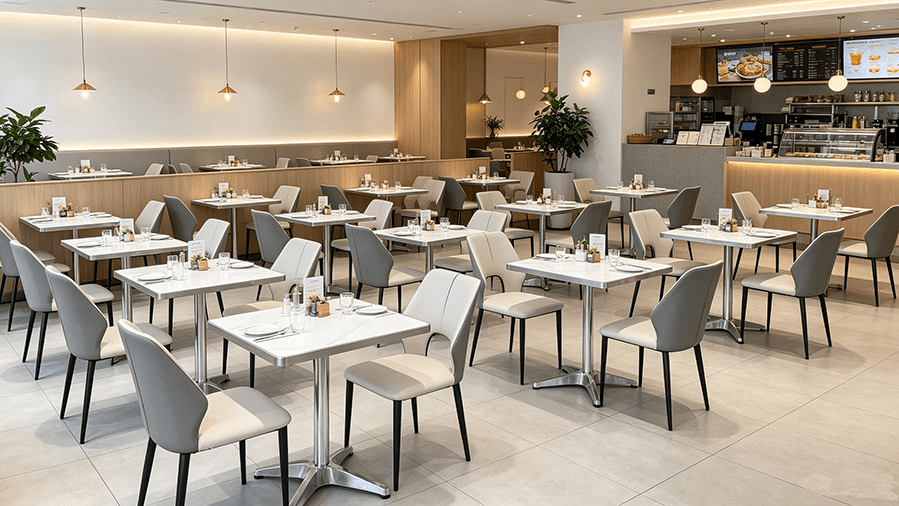
Recommended Base Materials for Wooden Tops
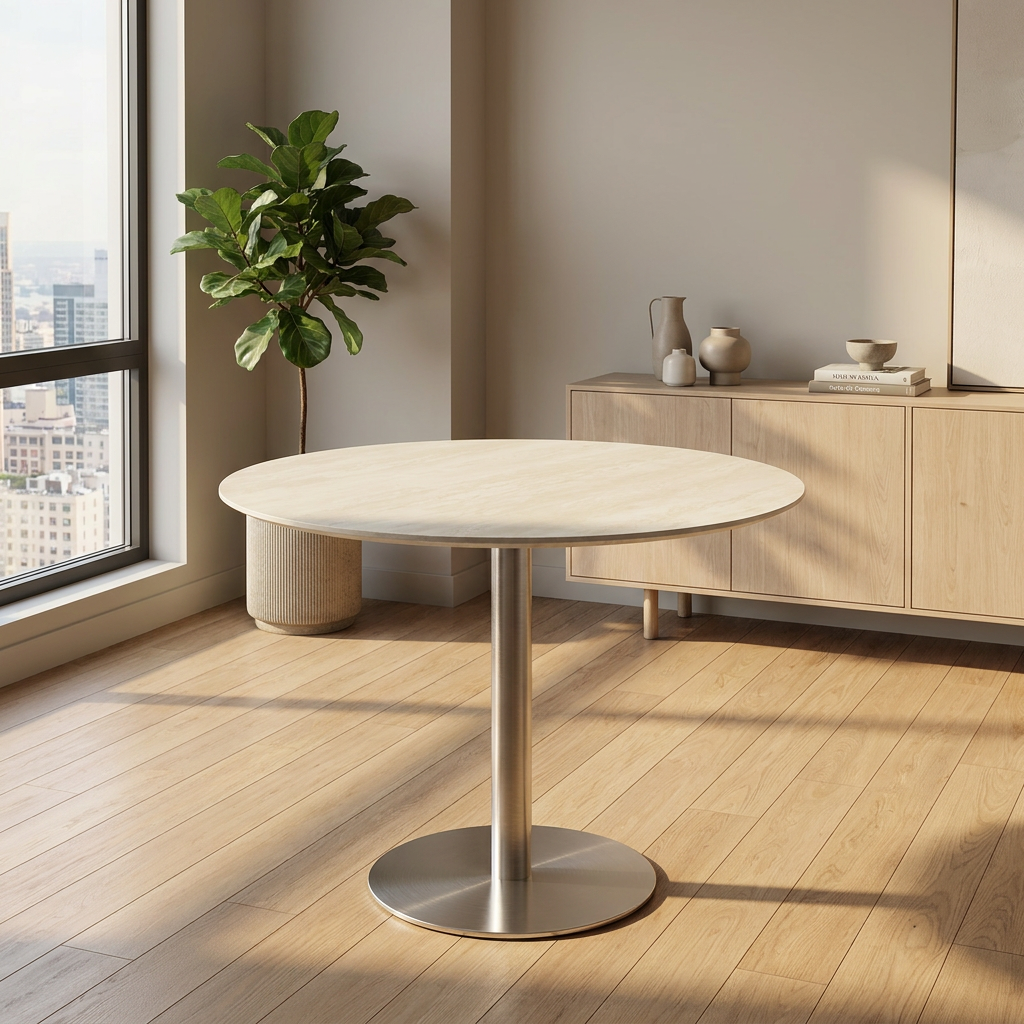
Stainless Steel Table Bases— Premium Pairing for Modern Wooden TablesStainless
steel paired with solid wood creates one of the most sought-after contemporary aesthetics.| Grade | Finish Options | Wood Pairing | Price Tier |
| SS 304 | Brushed, satin, mirror | Oak, walnut, ash, teak | $$$ |
| SS 201 | Brushed, mirror | Pine, rubberwood, acacia | $$ |
Cast Iron Table Base— Traditional Elegance
For farmhouse, rustic, and traditional interiors, cast iron bases offer unmatched character:
Ornate patterns, low center-of-gravity stability, classic claw-foot designs
The Golden Ratio: Base Size vs. Tabletop Size
The base-to-top ratio is critical for both visual proportion and structural safety. Too small = tipping risk and awkward proportions; too large = cramped legroom and heavy appearance.
Golden Ratio Rules
| Table Shape | Base Footprint Rule |
| Rectangular | Base width = 55%–70% of top width |
| Round | Base diameter = 60%–75% of top diameter |
| Oval | Base width = 50%–65% of top width at widest point |
Square | Base width = 60%–70% of top side length |
Size Reference Table
| Tabletop | Recommended Base Footprint | Recommended Base Type |
| 600 × 600 mm | 400 × 400 mm | Flat plate single pedestal |
| 700 × 700 mm | 450 × 450 mm | 4-claw base |
| 800 × 800 mm | 500 × 500 mm | Cross-leg |
900 × 900 mm | 540 × 540 mm | Sculptural leg base
|
Round Table Reference
| Tabletop | Recommended Base Footprint | Recommended Base Type |
| 600 mm | 400 mm | Single pedestal |
| 700 mm | 450 mm | Single pedestal |
| 800 mm | 500 mm | Wide pedestal or 4-leg |
900 mm | 540 mm | Sculptural leg base |
Frequently Asked Questions
| Question | Answer |
| Can the same base be used for both sintered stone and wood? | Generally no. Sintered stone bases prioritize wide, rigid support with adhesive mounting; wooden bases require flexible, slotted screw connections. A sintered stone-rated base CAN be adapted for wood if you add slotted brackets and isolation washers. |
| What thickness of sintered stone is best for dining tables? | 12 mm is the industry standard for tables up to 2 m. |
| Which wood species is best for a dining tabletop? | Oak (durable, classic grain), walnut (luxury, dark tones), and ash (light, modern) are the top three choices. Acacia offers excellent value with unique grain patterns. Avoid softwoods like pine for daily-use dining tables. |
How do I prevent the table from wobbling on uneven floors? | All our custom bases include heavy-duty adjustable leveling feet with a 0–17 mm adjustment range. |
How long does custom production take? | Standard production: 15–30 days. Complex designs or large-volume orders may require 30–45 days. Rush service is available — contact us for current lead times. |
Do you offer OEM/ODM services? | Yes, we provide full OEM/ODM services: custom dimensions, materials, finishes, packaging, and branding. MOQ depends on design complexity — contact us with your specifications. |
Get Your Custom Quote Today
Whether you need a heavy-duty base for a sintered stone dining table or an elegant stainless steel frame for a solid wood masterpiece, we manufacture engineering-grade custom table bases to your exact specifications.
Why choose us:
Custom dimensions for any tabletop size and shape
Material expertise: stainless steel (304/201), aluminum alloy, cast iron
Finish options: powder coating, brushed, polished, electroplating
Worldwide shipping with reinforced packaging for fragile tops
Contact us today to discuss your project. Share your tabletop material, dimensions, preferred style, and quantity — we'll provide a detailed quotation within 24 hours.
📞 WhatsApp: +86 17841353079
📧 Email: aeonti@aeonti.com
🌐 Website: www.aeonti.com