From Furniture Drawing to Production: How Commercial Table Bases Are Engineered for OEM Projects
- Share
- publisher
- AEONTI
- Issue Time
- Oct 28,2026
Summary
How a custom commercial table base goes from drawing to mass production: engineering review, structural optimization, material selection, CAD, prototyping, testing, surface finish, QC and export packaging, plus how AEONTI supports OEM table base projects from your drawing, sample or sketch.
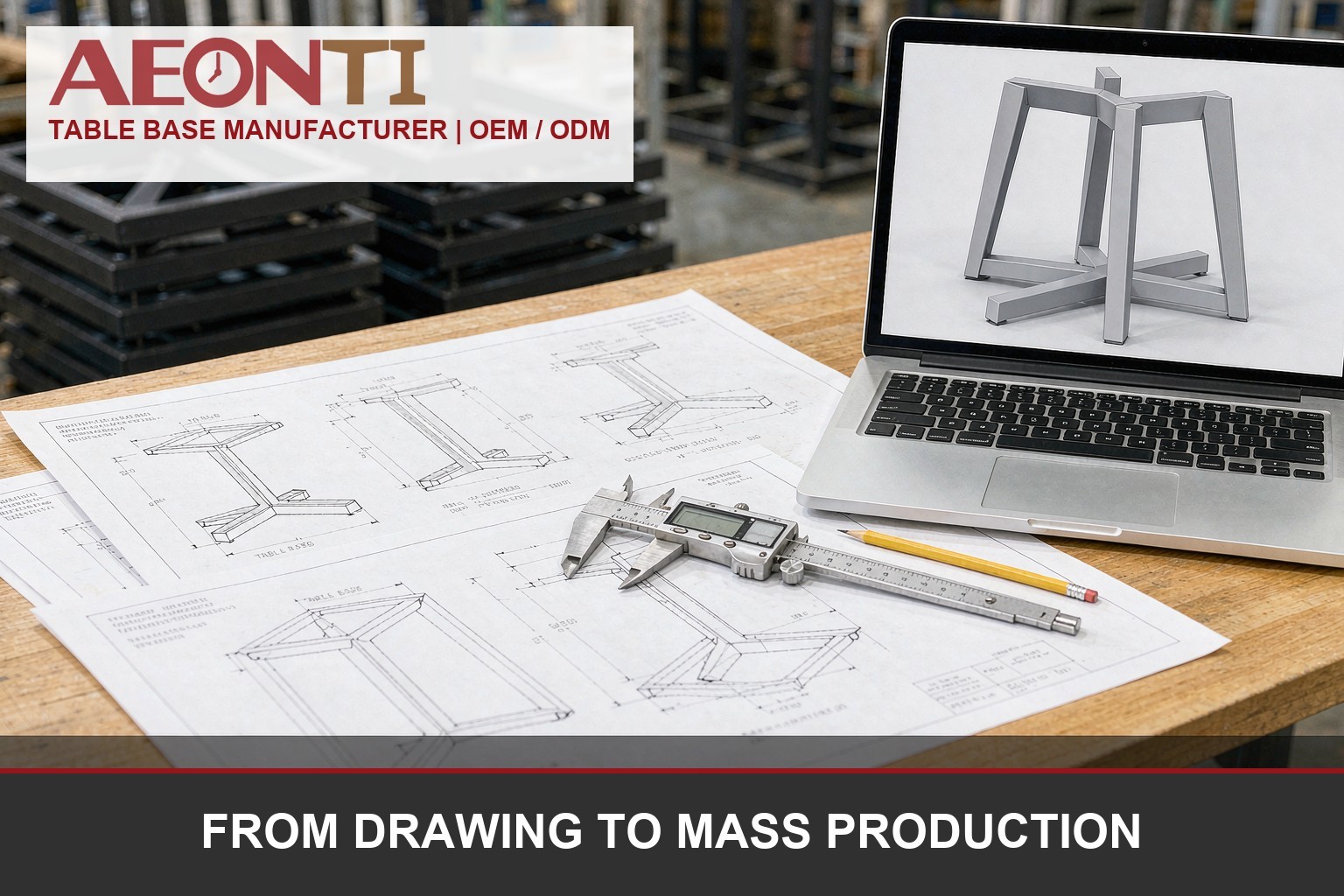
From Furniture Drawing to Production: How Commercial Table Bases Are Engineered for OEM Projects
For restaurants, hotels, cafes, furniture brands and commercial furniture wholesalers, developing a custom commercial table base is rarely as simple as handing a drawing to a factory and waiting for finished products.
A truly professional OEM project goes through a complete engineering chain:
Design Drawing → Engineering Review → Structural Optimization → Prototype → Sample Approval → Mass Production → Quality Control → Export Packaging
From the first 2D/3D drawing to a commercial table base that can be mass-produced stably, the process involves structure, materials, dimensions, welding, surface finish, mounting methods, packaging and shipping.
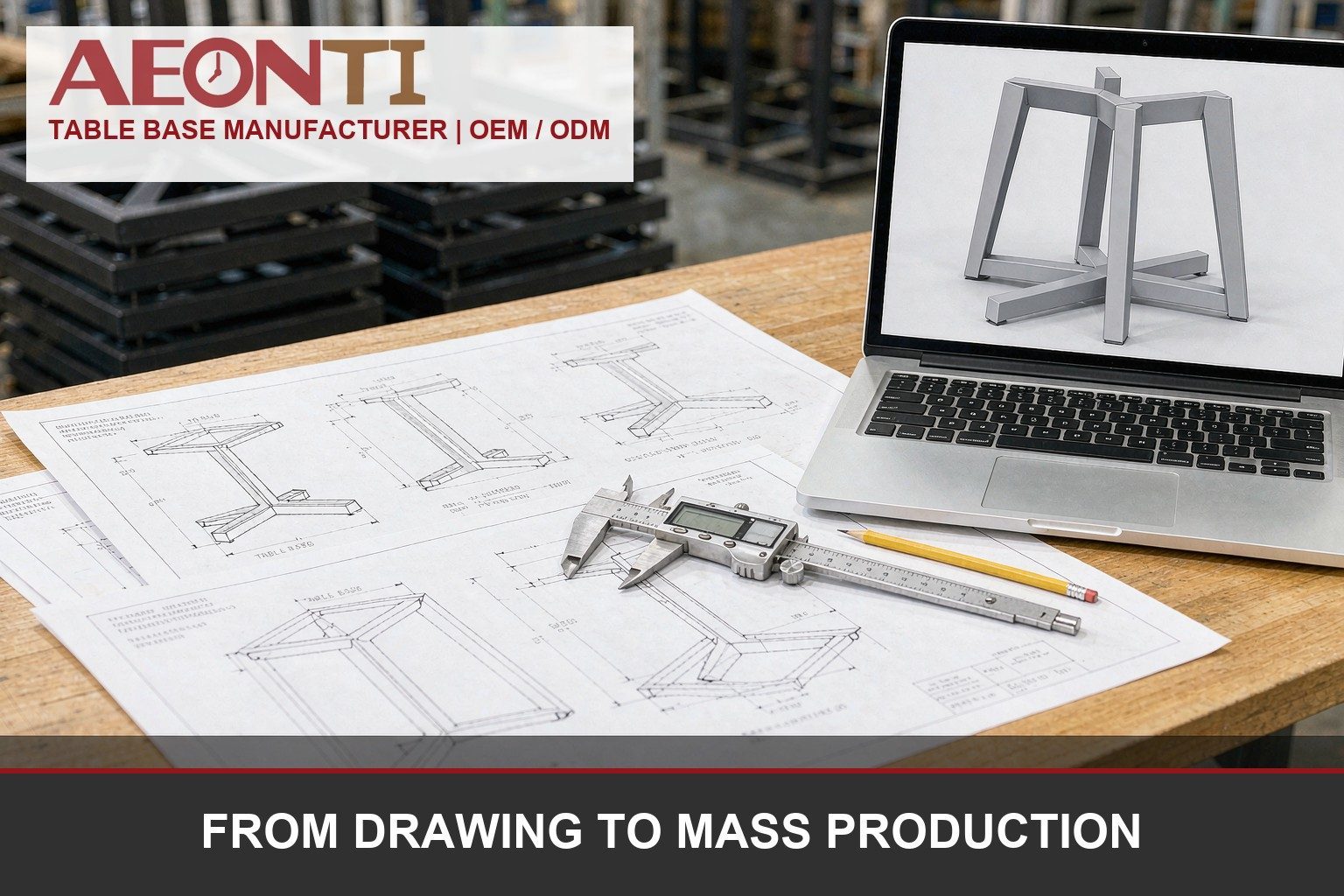
Especially for restaurants, hotels and commercial projects, a table base must not only "look good" — it has to stay stable and durable in daily use, and match the specified table top size and mounting method.
So if you are looking for an OEM manufacturer that can develop commercial table bases from drawings, samples or even hand sketches, understanding the complete engineering process from design to production is essential.
Why Engineering Matters in Commercial Table Base OEM Projects
A commercial table base looks structurally simple, but in fact it has to solve several problems at the same time:
- Stability
- Legroom (chair and knee clearance)
- Mounting Compatibility with the table top
- Material Strength
- Surface Finish
- Production Feasibility
- Packaging & Shipping
A design that only considers appearance will very likely run into problems once it enters production. For example:
- An undersized base footprint, causing the table to wobble
- A poorly positioned column that blocks chairs and legroom
- Top plate hole patterns that do not match the table top
- Tube specifications that cannot survive commercial use
- Welding positions so complex that production efficiency drops
- A surface finish that does not match the material
- A producible product whose packaging makes shipping far too expensive
The core question of OEM table base development is therefore not:
"Can we make this?"
but rather:
"Can we make it stable, repeatable, cost-effective and suitable for mass production?"
From Furniture Drawing to a Production-Ready Table Base
A commercial table base project can start from many kinds of design input:
| Customer Input | What the Factory Can Do |
|---|---|
| 2D Drawing | Confirm dimensions, hole positions and structure |
| 3D CAD Drawing | Analyze structure and production method |
| Product Sample | Measure and replicate / optimize |
| Hand Sketch | Redesign based on your requirements |
| Product Photo | Judge the structure and confirm specifications |
| Tabletop Specification | Select a suitable table base structure |
| Existing Table Base | Develop a modified version of an existing model |
This means that not having complete engineering drawings does not necessarily stop a project. Even if you only have:
a hand sketch + tabletop size + application + quantity
a professional OEM manufacturer can start the engineering evaluation from this basic information — and recommend whether a pedestal table base, a cross table base or a custom structure is the right starting point.
Step 1: Engineering Review of the Original Drawing
After receiving a customer drawing, the first step is not immediate quoting — it is the Engineering Review. The engineering team usually needs to confirm:
1. Overall Dimensions
- Base Width
- Base Depth
- Column Height
- Top Plate Size
- Tube Diameter
- Tube Thickness
2. Tabletop Compatibility
The table base must be checked against the specified table top:
- Tabletop Size
- Tabletop Shape
- Tabletop Material
- Tabletop Weight
For example, a Ø600 mm round table and a 1800 × 800 mm rectangular dining table usually require completely different base structures.
3. Mounting Method
- Screw Hole Position
- Mounting Plate
- Threaded Inserts
- Bolt Connection
- Top Plate Design
Because the connection between the table base and the table top directly affects installation efficiency and final stability.
Step 2: Structural Optimization for Commercial Use
The customer's design is not necessarily the final production version. In an OEM project, a good manufacturer should be able to tell you which parts can be produced directly and which parts should be optimized.
Base Footprint — a smaller base is not always better. If the table top is large but the base is too small, overall stability suffers.
Column Position — the column position affects chair position, legroom and table stability at the same time. In restaurant projects, buyers usually need to balance stability and seating comfort, especially when pairing the base with commercial dining chairs.
Top Plate — the top plate cannot be designed by appearance alone. It must consider tabletop size, tabletop weight, the number of fixing screws, hole positions, installation tools and forces during transportation.
This is why professional OEM projects usually require several rounds of confirmation at the design stage.
Step 3: Selecting the Right Material
Commercial table bases can be manufactured from different materials depending on the application:
| Material | Key Features | Common Applications |
|---|---|---|
| Stainless Steel | Corrosion resistant, premium appearance | Restaurants, hotels, outdoor |
| Iron | High strength, flexible processing | Restaurants, cafes, commercial furniture |
| Cast Iron | Heavy weight, excellent stability | Restaurants, hotels, commercial projects |
| Aluminum | Lightweight, corrosion resistant | Outdoor, commercial spaces |
| Mixed Materials | Balances structure and design | High-end commercial projects |
Material selection is not about choosing the most expensive option. The correct way is to decide based on:
Application + Tabletop + Load + Environment + Target Price
For example, outdoor projects usually need more attention to corrosion resistance, while a large dining table needs more attention to stability and load distribution.
Step 4: Turning the Drawing into a Production-Ready CAD Design
After the structure is confirmed, the engineering team converts the customer design into complete production documentation, typically including:
- 2D Production Drawing
- 3D CAD Model
- Material Specification
- Tube Specification
- Plate Thickness
- Welding Position
- Hole Pattern
- Surface Finish
- Packaging Specification
This stage is critical, because:
Customer Design ≠ Production Drawing
The customer's drawing expresses "I want this product." The production drawing must answer "How exactly should this product be manufactured?"
Step 5: Prototype and Sample Development
Once the design is fixed, the project enters Prototype / Sample Development. For a custom commercial table base, the sample stage is extremely important, because many problems can only be discovered on a physical unit. For example:
- Is the table base too heavy?
- Does the base take up too much floor space?
- Is the table top easy to install?
- Can chairs approach the table normally?
- Is the table surface stable?
- Does the product proportion match the design intent?
- Does the surface color match the brand requirement?
For this reason, OEM projects should not skip sample confirmation and jump directly into mass production. The recommended flow is:
Drawing → Prototype → Sample Inspection → Customer Approval → Mass Production
Step 6: Testing Stability and Function
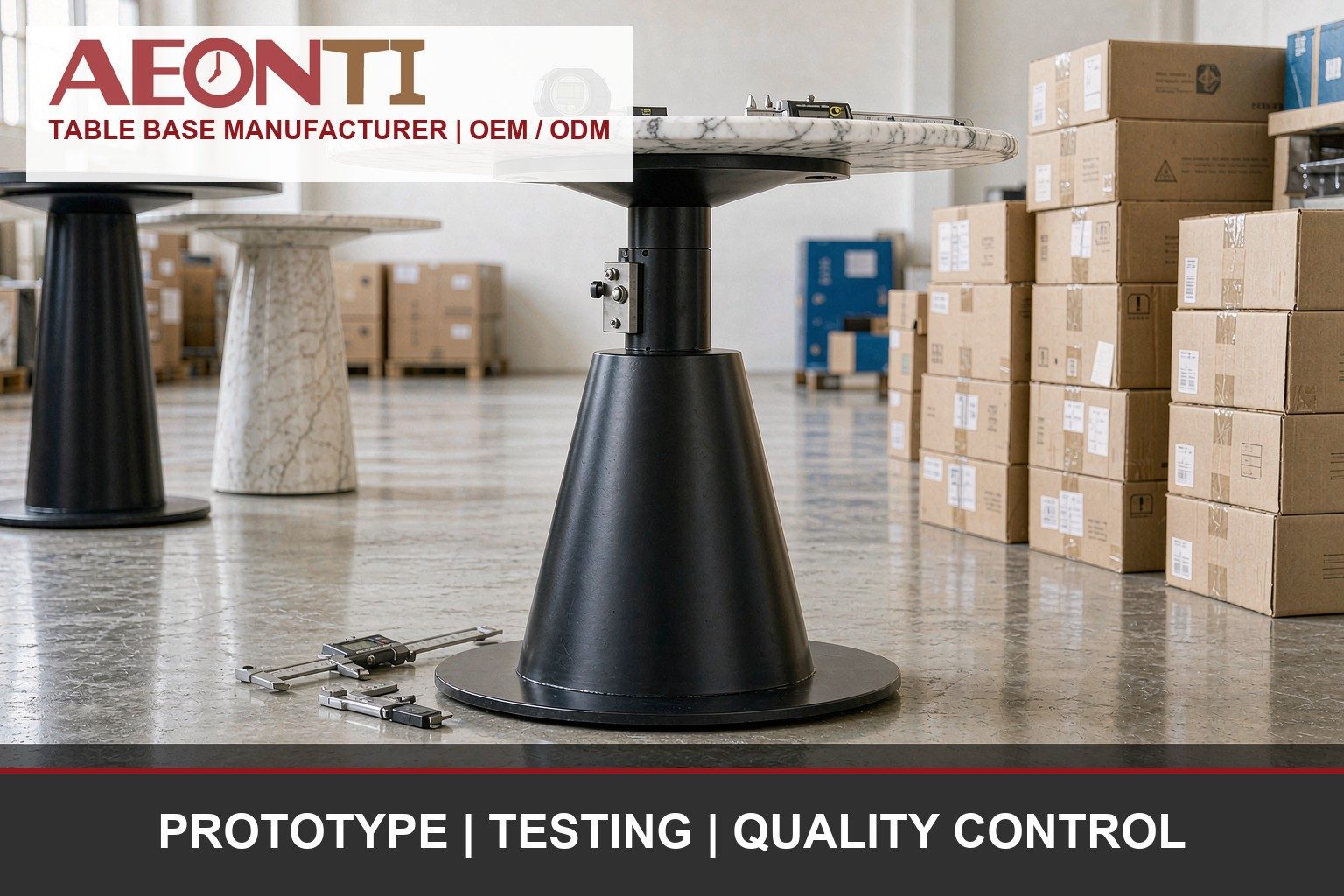
For commercial dining tables, stability is essential, because tables in restaurants, cafes and hotels see intensive daily use. Customers may move tables, lean on the table top, place heavy objects, use the table frequently, clean it repeatedly and use it for many hours a day.
Before mass production, the following points should be carefully checked:
- Stability — does the table wobble easily?
- Load Performance — does it stay stable under real usage conditions?
- Connection — is the connection between the table base and the table top firm?
- Leveling — can it be adjusted on different floor conditions?
- Surface — is the finish even and suitable for the target environment?
Step 7: Surface Finish Is Part of OEM Engineering
Many buyers believe that once the color is confirmed, everything is settled. In fact, for commercial furniture OEM projects, the surface finish also needs engineering confirmation. Common options include:
- Powder Coating
- Brushed Stainless Steel
- Polished Stainless Steel
- Electroplating
- Custom RAL Color
For example, the same "black" can mean Matte Black or Textured Black — two completely different visual results. So in OEM projects it is best to confirm Color + Texture + Gloss + Physical Sample before mass production, instead of just saying "black finish".
Step 8: From Sample Approval to Mass Production
Only after the customer approves the sample does the project truly enter Mass Production. The most important question at this stage is:
"How do we make every unit consistent?"
A good sample does not automatically guarantee a stable batch. Commercial furniture OEM production must control: Material, Cutting, Bending, Welding, Grinding, Surface Treatment, Assembly, Inspection and Packaging.
The core of mass production is Repeatability — every batch should stay as close as possible to the approved sample.
How Commercial Table Bases Are Manufactured
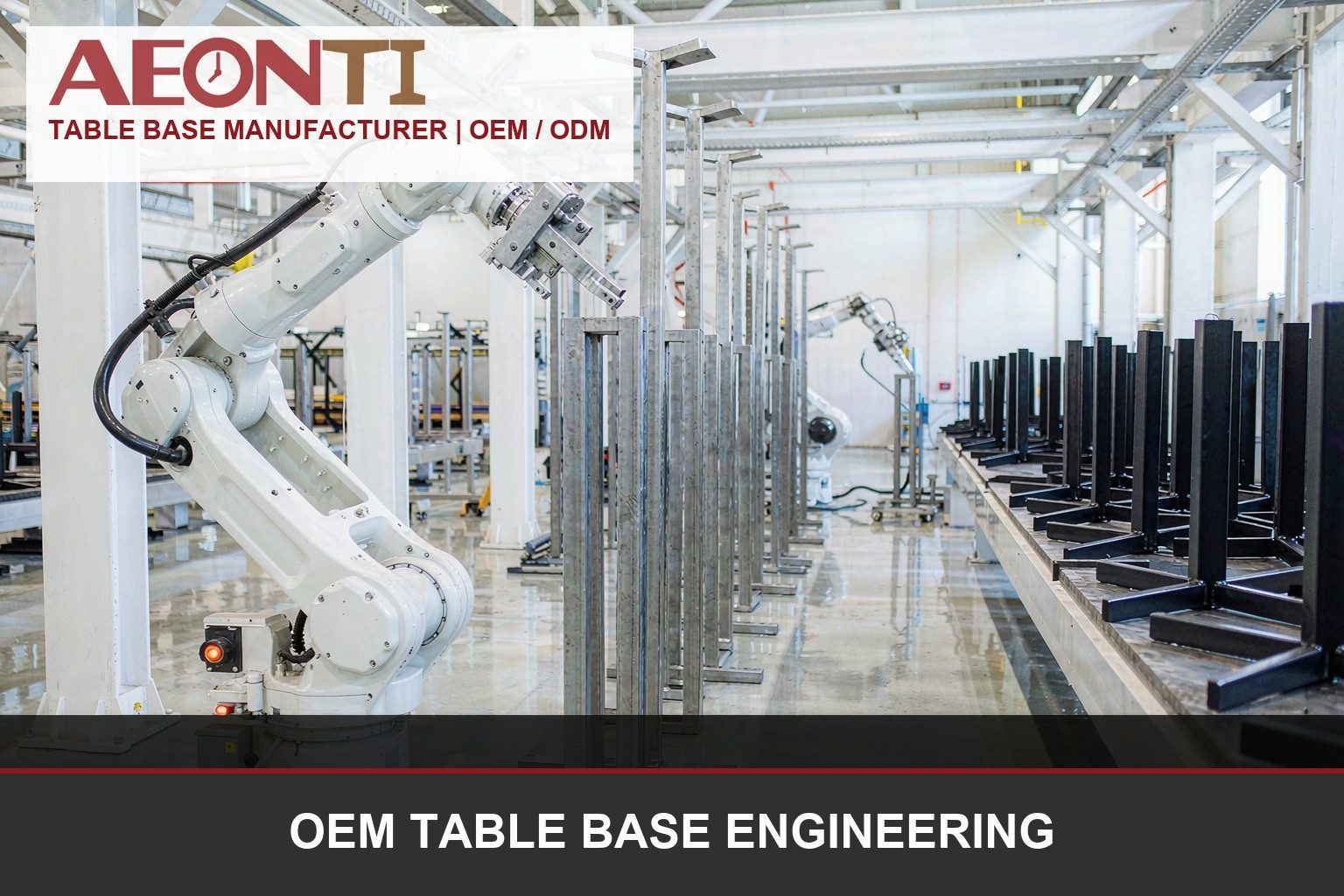
Different table base structures correspond to different manufacturing processes.
Metal welded table bases typically involve:
Tube Cutting → Bending → Drilling → Welding → Grinding → Surface Treatment → Assembly → QC
While cast iron table bases typically involve:
Pattern → Casting → Machining → Grinding → Coating → Assembly → Inspection
This is why the manufacturing process should be considered as early as the design stage: Which process is most suitable for this product?
Why Design for Manufacturing Matters in OEM Projects
A professional OEM project cannot only pursue "making the design happen". It also needs Design for Manufacturing (DFM) — making the design fit real mass production.
A design may look visually impressive, but if it requires heavy manual welding, special molds or complex machining, the result is:
- Production Cost ↑
- Lead Time ↑
- Quality Risk ↑
Conversely, a design optimized at the engineering stage delivers:
- Production Efficiency ↑
- Cost Control ↑
- Consistency ↑
- Delivery Stability ↑
This is also why OEM buyers should not compare suppliers by quotation alone.
Common OEM Table Base Problems That Engineering Can Prevent
Many problems that appear in projects can actually be solved before production:
| Common Problem | Possible Cause | Solved at Engineering Stage |
|---|---|---|
| Table Wobbling | Unreasonable base size / structure | Optimize structure and base footprint |
| Poor Legroom | Column position not reasonable | Adjust column position |
| Mounting Problem | Hole pattern mismatch | Confirm hole pattern |
| High Freight Cost | Structure cannot be knocked down | Design KD (knock-down) structure |
| Surface Scratches | Insufficient packaging | Optimize export packaging |
| Color Difference | Poor finish control | Confirm master sample |
| Difficult Assembly | Complex connection method | Optimize mounting structure |
| High Production Cost | Over-complicated process | DFM optimization |
| Inconsistent Batch | Insufficient process standards | Define production specification |
OEM Table Base Packaging Should Be Considered Before Production
Packaging is not something to think about after production. If a product follows the path of design → production → then packaging, you may find:
- Cartons far larger than necessary
- Products colliding inside the box
- Low container loading efficiency
- High packaging cost
- Easily scratched surfaces
So an OEM project should consider Product + Packaging + Container Loading from the design stage. For example, with a Knock-Down Design, the package volume can be reduced and container loading efficiency significantly improved — the same principle we explained in our guide on packing commercial table bases for wholesale shipping.
From Drawing to Production: The Complete OEM Workflow
A mature commercial table base OEM project typically moves through the following workflow:
| Stage | Main Work | Customer Confirmation |
|---|---|---|
| 01. Design | Drawing / sketch / sample | ✓ |
| 02. Engineering Review | Structure and production feasibility analysis | ✓ |
| 03. CAD | Complete 2D/3D production drawings | ✓ |
| 04. Quotation | Costing of material, quantity, process | ✓ |
| 05. Prototype | Sample making | ✓ |
| 06. Testing | Stability, assembly, appearance check | ✓ |
| 07. Sample Approval | Confirm final sample | ✓ |
| 08. Mass Production | Batch production | — |
| 09. QC | Batch quality inspection | ✓ |
| 10. Packaging | Export packaging | ✓ |
| 11. Loading | Container loading | — |
| 12. Shipment | Dispatch | — |
How AEONTI Supports Custom Commercial Table Base OEM Projects
For overseas customers with OEM requirements, AEONTI can start product development from your drawing, sample or sketch. Custom projects can be adjusted around the following parameters:
- Base Diameter
- Base Width
- Base Depth
- Column Height
- Top Plate Size
- Tube Specification
- Material — stainless steel, iron and more
- Finish & Color
- Leveling Feet
- Mounting Holes
- Packaging
- Private Label
For furniture brands, wholesalers and commercial project buyers who already have product designs, this means you do not need to search for standard products from zero — you can hand your design requirements directly to the manufacturer for engineering evaluation.
AEONTI's current commercial table base range covers stainless steel, iron and other types, with OEM/ODM and custom size services. If you already have a drawing, sample or hand sketch, we can provide an engineering evaluation and quotation based on your specific specifications.
Why Choose a Factory That Understands Both Engineering and Production?
A supplier truly suitable for OEM projects should not just "produce according to the drawing". It should be able to:
Read → Review → Optimize → Prototype → Produce → Inspect → Pack
Because what really decides the success of an OEM project is not whether the product can be made, but:
- Can it be produced stably?
- Can the cost be controlled?
- Can batch consistency be guaranteed?
- Can delivery meet the project timeline?
- Can shipping and packaging risks be reduced?
This is the manufacturing capability that commercial furniture OEM projects really need.
From Your Drawing to Your Production-Ready Table Base
If you already have a CAD drawing — we can run an engineering evaluation based on it.
If you only have a hand sketch — just provide your dimensions and usage requirements first.
If you have a physical sample — it can be used for custom development or as a structural reference.
You only need to tell us:
| # | Information to Provide | Example |
|---|---|---|
| 1 | Tabletop Size | Ø600 mm round / 1800 × 800 mm rectangular |
| 2 | Table Height | 750 mm dining height / 1100 mm bar height |
| 3 | Quantity | Pilot order or full project volume |
| 4 | Material | Stainless steel / iron / cast iron / aluminum |
| 5 | Finish / Color | Matte black powder coating / brushed steel / RAL code |
| 6 | Application | Restaurant / hotel / cafe / food court |
| 7 | Target Market | Country or region and relevant standards |
AEONTI can then evaluate your project step by step:
Structure → Material → Production → Sample → Mass Production → Packaging
— turning your design from a single drawing into a commercial table base that can be mass-produced and delivered on time.
Request Your Custom Commercial Table Base Solution
Have a drawing, sample or hand sketch? Send it to AEONTI today.
Tell us your tabletop size, quantity, material, height and finish requirements, and our engineering team will help you evaluate the right OEM solution for your commercial furniture project — free of charge.
| What You Send | What You Get Back |
|---|---|
| Drawing / sketch / sample + basic specs | Feasibility feedback within 24 hours |
| Tabletop size, quantity, target price | Engineering suggestions & optimized structure proposal |
| Confirmed requirements | Formal quotation & lead time |
| Sample approval | Mass production, QC & export shipping |
And to make your project easier, AEONTI also supports you with:
- Free engineering review of your drawing or sketch before quoting
- Free 3D renderings to visualize the product with your table top before tooling
- Sample arrangement so you can test stability and finish before mass production
- One-stop supply — matching commercial chairs, table tops and complete tables from the same factory
- Export packaging & loading optimization to reduce your freight cost
👉 Send us your drawing or requirements now — get a professional engineering evaluation and a custom table base quotation within 24 hours.