One Table, One Space: The Complete Guide from Tabletop Materials to Table Leg Craftsmanship
- Share
- publisher
- Cinnia
- Issue Time
- Aug 7,2026
Summary
A full buying guide for commercial dining tables tailored to hotel, restaurant & café project buyers. Compare sintered stone, wood, HPL tabletops & cast iron, stainless steel, aluminum alloy table legs, learn scenario matching, structural stability, bulk procurement skills and full OEM/ODM customization support from AEONTI, a reliable China commercial furniture manufacturer with rich export experience.
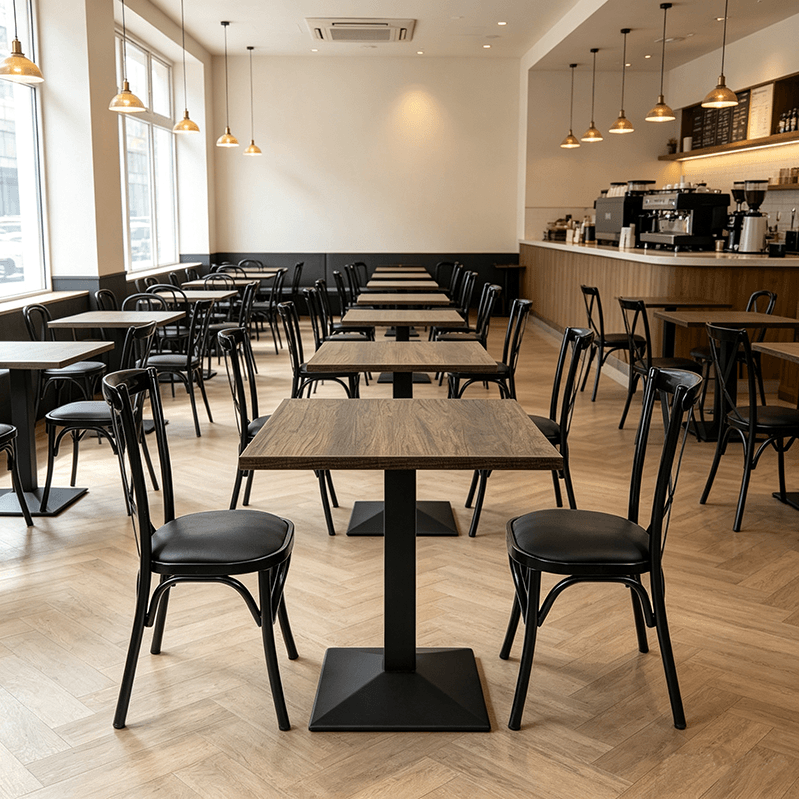
For restaurants, hotels, and wholesale buyers, a dining table is never just "a place to put the food" — it is where customer experience, operational efficiency, and brand identity meet. This guide covers five dimensions — business value, materials and craftsmanship, scenario-based selection, procurement and customization — to help you choose the right table in one pass.
Introduction: Why the Table Is a Restaurant's First Piece of Furniture
What do customers see first when they walk into a restaurant? The lighting, the space, the smile of the staff... But before they actually sit down, their eyes will inevitably land on a table. The texture of the tabletop, the lines of the legs, the stability the moment you sit down — all of it sends a signal within seconds: What level is this place, and is it worth sitting down for?
For B2B buyers — wholesalers, hotel project teams, and restaurant chains — a dining table is an investment made at "high frequency and high intensity": it is used for more than a dozen hours every day, enduring hot soup, wine stains, impacts, and repeated wiping. Choose the wrong material or structure, and you face frequent repairs at best, or damaged reputation and lower table turnover at worst.
As a manufacturer specializing in table legs, tabletops, and complete dining table and chair sets, AEONTI has been deeply rooted in the industry for many years with rich export experience, serving wholesalers, hotel projects, and restaurants around the world. Today, we have turned the experience accumulated from years of serving customers into a systematic guide to help you avoid detours on your procurement journey.
The Business Value of a Dining Table: Experience, Turnover, and Brand
Many operators treat the dining table as "furniture we simply have to buy," overlooking the real leverage it has on their
business. The right table can influence customer experience, spatial efficiency, and brand perception all at once:
| Business Factor | Role of the Dining Table | Key Points |
| Customer experience | Direct carrier of comfort and quality | Tabletop feel and leg stability determine whether guests
feel at ease |
| Table turnover | Size and layout define seating density | Table shape and top size affect output per square meter |
| Brand identity | Core expression of spatial style | Materials and colors convey class and theme |
Maintenance cost | Durability determines long-term cost | Stain-, heat-, and rust-resistant materials reduce replacement frequency |
On the experience side: a stable frame that never wobbles and a warm, durable tabletop let customers focus on the food and
the conversation — and a tabletop texture that "photographs well" is free publicity in the age of social media.
On the efficiency side: fast-food and café businesses live on turnover; the ratio of small square tables to round tables directly
affects daily guest capacity, while banquet halls rely on large round tables and Lazy Susans to maximize the value of each
table.
On the brand side: the cool modernism of sintered stone, the warm naturalness of wood, the industrial feel of metal —
materials themselves are the language of spatial design and the most economical way to express brand identity.
Tabletop Materials Explained: Sintered Stone, Artificial Marble, Wood, and HPL
The tabletop is the "face" of the table — it comes into direct contact with food, tableware, and customers' elbows, and it bears
the brunt of wear and cleaning pressure. AEONTI's tabletop range covers four mainstream materials, each with a clearly
defined fit:
| Comparison | ||||
| Appearance &
texture | Natural stone
veining, grand and
modern | Smooth and lustrous,
can mimic natural
stone | Natural warmth,
suits any style | Rich textures, can
imitate wood or
stone |
| Heat
resistance | Excellent — hot
pans can be placed
directly | Good — heat pads
recommended | Fair — avoid
prolonged high
heat | Good — withstands
brief high heat |
| Scratch &
abrasion
resistance | Excellent | Good | Fair — requires
regular care | Good |
Stain
resistance &
cleaning | Excellent — resists
penetration | Good | Fair — needs
protective coating | Good — easy to
clean |
Rigidity &
load capacity | High | High | Medium | Medium |
Cost
positioning | Mid-to-high | Mid | Mid | Budget-friendly |
Best-fit
scenarios | High-end hotels,
fine-dining
restaurants | Banquet halls, mid-to-high-end
restaurants | Cafés, casual
dining, home-style
spaces | Fast-food chains,
cafeterias, outdoor
seating |
Sintered stone: formed from natural minerals under high temperature and pressure, it offers high hardness, excellent heat
resistance, and stain resistance — currently the first choice for high-end dining spaces. The trade-off is higher requirements for
fabrication and installation, and a higher cost.
Artificial marble: a composite of resin and stone powder, offering a warm, smooth feel with controllable veining — you can
achieve a look close to natural stone at a lower cost, ideal for banquet halls and mid-to-high-end restaurants that want quality
without blowing the budget.
Wood: naturally warm and highly adaptable in style, it remains a perennial favorite in cafés, casual restaurants, and brand
spaces that emphasize "warmth." Pair it with a quality coating and proper cleaning to extend its service life.
HPL (high-pressure laminate): offers an extremely wide choice of colors and textures with an easy-to-clean surface — the goto option for high-frequency scenarios such as fast-food chains.
Table Leg Materials Explained: Choosing Among Five Metals
If the tabletop is the "face," the legs are the "backbone" — they carry the full load, determine stability, and define the
structural character of the product. AEONTI's table leg range covers five materials — stamped iron, cast iron, aluminum alloy,
iron, and stainless steel — each with its own personality:
| Comparis
on | Iron-Stamping-Table-Bases | Stainless
Steel table base | |||
| Strength &
load
capacity | Good | Excellent | Good | Good | Excellent |
| Weight | Medium | Heavy | Light | Medium | Medium |
| Rust &
corrosion
resistance | Needs coating
protection | Needs coating
protection | Excellent —
natural oxide
film | Needs coating
protection | Excellent |
Process
characteri
stics | Die-stamped
forming, ideal for
volume production | One-piece
casting, heavy
and solid
profile | Extrusion/die-casting, can be
lightweight | Tube welding,
highly versatile | Polished/bru
shed,
premium
look |
Surface
finishing | Powder coating,
etc | Powder
coating, etc. | Anodizing /
coating | Powder
coating, etc. | Polishing /
brushing /
plating |
Cost
positionin
g | Budget-friendly | Mid-to-high | Mid-to-high | Budget-friendly | Mid-to-high |
Best-fit
scenarios | Fast-food chains,
cafeterias | Banquet halls,
vintage-style
restaurants | Cafés, light-fare
shops, outdoor
seating | Standard
restaurants,wholesale
volume | High-end
restaurants,
hotels |
Stamped iron: formed in a single die-stamping operation, offering high consistency and controlled cost — the main solution
for high-volume purchasing by chain operators.
Cast iron: cast as one piece, heavy and strong, with a natural vintage and ceremonial feel — well suited to banquet halls and
spaces that emphasize gravitas.
Aluminum alloy: the balance of lightweight and corrosion resistance; combined with anodizing, it excels in outdoor and lightfare scenarios.
Iron (carbon steel): the most versatile and cost-effective option; with powder coating it covers the vast majority of indoor
scenarios — a classic choice for wholesale and volume orders.
Stainless steel: rust-resistant, corrosion-proof, and premium in feel; polished and brushed finishes add extra points in highend hotels and open-kitchen areas, with low long-term maintenance costs.
Choosing by Business Type: Hotels, Restaurants, and Cafés
There is no "best" material — only the "most suitable" combination. Below are recommended pairings by common business
type, ready to serve as the starting point for your procurement plan:
| Business Type | Recommended
Tabletop | Recommended Legs | Core Priority |
| High-end hotels /
banquet halls | Sintered stone,
artificial marble | Cast iron, stainless
steel | Texture, stability, durability |
| Mid-to-high-end
restaurants | Sintered stone,
artificial marble | Stainless steel, iron
(coated) | Balance of class and cost |
| Fast-food chains | Wood | Stamped iron | Economy, easy maintenance,
consistent image |
Cafés / light-fare shops | Wood, sintered stone | Aluminum alloy, iron
(coated) | Lightweight, stylish |
Outdoor terraces | HPL | Aluminum alloy,
stainless steel | Weather resistance, rust
resistance |
A quick rule of thumb: first define the scenario (indoor/outdoor, high/low frequency), then choose the tabletop (the face), then
the table legs (the backbone), and finally complete stability with structural components (base plates, floor glides).
Structure: The Silent Hero — Stability, Load-Bearing, and Safety
Customers will never see a "cross brace" on the menu, but a single wobble can become the source of a bad review. Structuraldesign is the core differentiator of table quality. Below are the inspection dimensions commonly used in the industry (specific
parameters are subject to AEONTI's product specification sheets):
| Inspection Item | Reference Points |
| Leg-to-tabletop connection | Mounting plate thickness; matching of screw count and hole sizes |
| Cross braces & base plates | Cross braces enhance wobble resistance; base plates increase ground contact area |
| Load-bearing design | Frame capacity should cover normal use at full occupancy with tableware |
Anti-slip & protection | Floor glides prevent slipping and floor scratches |
Surface protection | Powder coating thickness; rust-prevention treatment level |
| Common
Problem | Main Cause | How to Avoid |
| Wobbling
table | Missing cross brace; loose installation | Choose legs with cross braces |
| Rust | Insufficient surface protection; humid
environment | Select coated/stainless steel materials; assess
ambient humidity |
| Tabletop
cracking | Mismatch between material and
structural stress | Choose material by purpose; install and fix properly |
Scratches &
wear | Insufficient hardness; improper
cleaning | Choose high-hardness tabletops; use soft cloths and
neutral cleaners |
Wholesale and Project Procurement: How to Buy Smarter
Wholesalers and hotel project teams buy in very different ways, but they share one pain point: information asymmetry. Check
the list below first, then talk to the manufacturer — it makes the conversation far more efficient:
Procurement checklist (7 items)
1. Define the purpose and usage scenario (indoor/outdoor, high-frequency/low-frequency)
2. Confirm dimensions, table types, and quantities
3. Tabletop material and texture requirements
4. Table leg material, color, and surface finish
5. Structural requirements (base plates, floor glides)
6. Packaging methods and shipping conditions
7. Lead times and phased delivery plans
| Dimension | Wholesale Procurement | Hotel / Project Procurement |
| Buying profile | Volume, standardized, price-sensitive | Customized, full-solution, strict lead
times |
| Key concerns | Lead time, price, batch consistency | Design fidelity, quality, stability, service |
| Common model | Standard products / stock items | Sampling, OEM/ODM, phased delivery |
Communication
focus | Volume pricing tiers, stock and
replenishment | Drawings, samples |
OEM/ODM: Customizing a Table That Belongs to Your Brand
The relationship between a mature buyer and a manufacturer often evolves from "buying products" to "building products
together." With full-category manufacturing capability, AEONTI supports OEM/ODM collaboration from single-item
customization to complete solutions:
| Customizable Item | Description |
| Dimensions & specs | Customized to space drawings and usage needs |
| Material combinations | Free pairing of tabletop × table legs |
| Colors & surfaces | Spray coating color charts, electroplating, brushing, anodizing, etc. |
Shape & structure | Custom design of leg profiles, cross braces, and base plates |
Brand elements | Logos, nameplates, custom packaging and shipping marks |
Complete solutions | Matching dining table and chair design with overall delivery |
Industry Trends: Where Dining Spaces Are Heading
Understand the trends, and today's procurement decisions won't fall behind tomorrow's spaces. In recent years, dining space
furniture has moved in five clear directions:
1. Lightweight and modular: the share of lightweight materials such as aluminum alloy keeps rising, and modular table
designs that combine flexibly have become a growth weapon for chain brands.
2. Multi-functional hybrid spaces: the same space plays different roles from morning to night, driving demand for tables that
can be joined together.
3. Sustainability and eco-friendliness: eco-friendly coatings, recyclable metals, and the idea that "durability equals less
waste" are becoming important criteria in project evaluation.
4. Minimalism with premium feel: design language is getting simpler, yet demands on touch, texture, and detail are higher
than ever.
5. Material mixing: sintered stone paired with wood, metal paired with stone — mixed materials are replacing the single-material "standard answer."
Why Choose AEONTI
When it comes to committing to a specific partner, AEONTI's confidence rests on these foundations:
| AEONTI Core
Capability | What It Means |
| Focus and depth | Specialized in table legs, tabletops, and complete dining sets — a focused product line |
| Export experience | Years of serving overseas wholesalers and project buyers, familiar with export standards and
logistics |
| Full material coverage | 4 tabletop materials × 5 leg materials for flexible combinations |
Dual service model | Wholesale volume and OEM/ODM customization in parallel — orders of any size welcome |
One-stop delivery | End-to-end follow-up from sampling, production, and QC to packaging and logistics |
Advice for buyers: whether it is your first bulk order or a full hotel project customization, do the three-step homework first —
"define the scenario + choose the material combination + confirm the structure" — then approach the manufacturer with your
checklist. It will make the process smoother and the results better.
Conclusion: It All Starts with One Table
A good dining table is the quietest yet most loyal asset in a restaurant — it serves customers for a dozen hours every day and is
almost never given a second thought. Let the tabletop express your quality, let the legs carry the daily grind, and let the
structure protect your reputation.
If you are planning a restaurant renovation, a hotel project, or a bulk order, feel free to contact AEONTI — request our catalog,
samples, and quotations, or share your customization ideas. With years of manufacturing experience and a mature export
service system, we are ready to be the reliable partner for your next project.
📞 WhatsApp: +86 17841353079
📧 Email: aeonti@aeonti.com
🌐 Website: www.aeonti.com