Plastic vs Metal vs Upholstered Dining Chairs: A Commercial Seating Selection Matrix for Restaurants, Hotels and Cafés
- Share
- publisher
- Zoey
- Issue Time
- Sep 15,2026
Summary
Plastic, metal or upholstered: the right commercial dining chair material is decided by four operating variables, not taste. This B2B guide compares the three materials at specification level, maps them to twelve venue zones from QSR to coastal terrace, and models five-year total cost of ownership, with failure modes, cleaning labour arithmetic and a supplier-ready specification checklist. Written for restaurant chains, hotel procurement, contractors and distributors buying in volume.
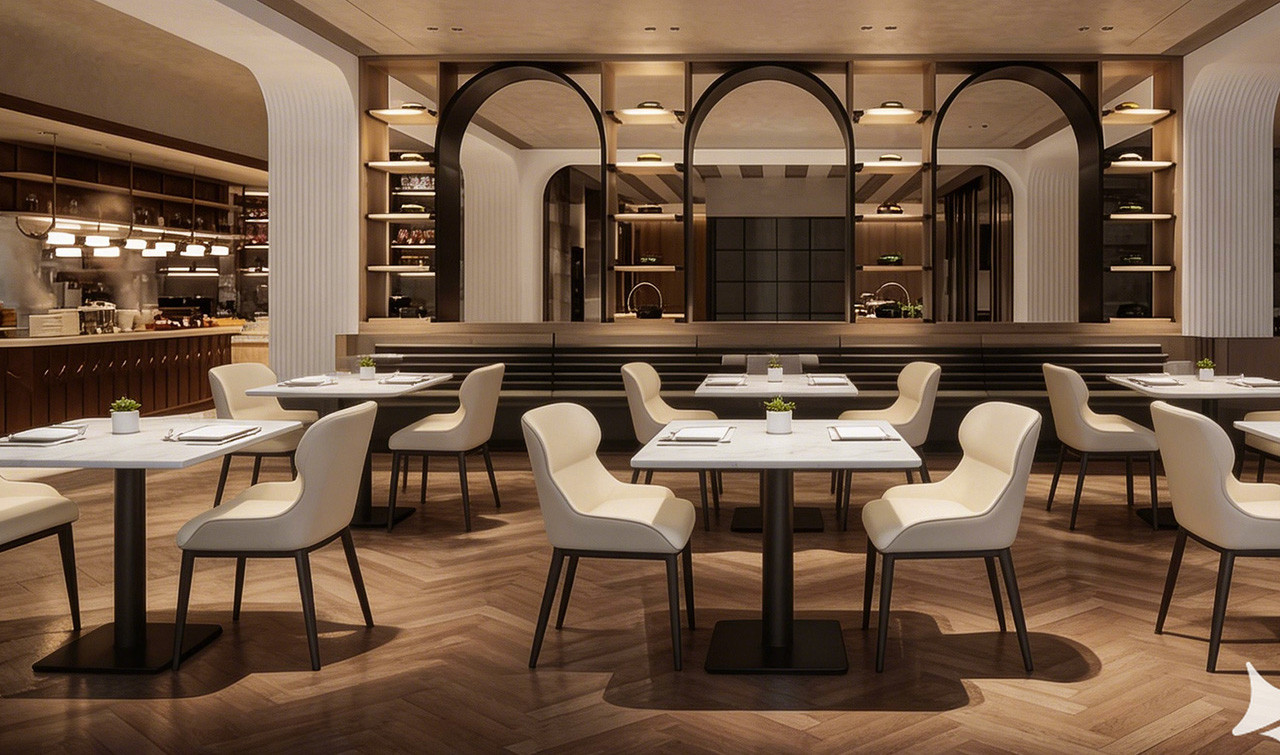
Most restaurant chair mistakes are made in a specification meeting, not on a factory floor. A 120-seat venue opens with upholstered chairs across the entire floor. Three months later the lunch trade — 200 covers, 45-minute turns, sauce on the seat twice a week — has flattened the foam, split two seams and pushed the cleaning labour line far past the budget the operator modelled. The chairs are not defective. They were specified for the wrong zone.
The reverse error is just as expensive. A café fits moulded plastic chairs throughout, including the area where guests read and work for two hours, and then wonders why weekend covers per table never rise. The chair is not uncomfortable because it is cheap; it is uncomfortable because it has no give, no breathability between the guest and the seat, and no visual signal that the venue expects a long stay.
This guide is written for restaurant chains, hotel procurement teams, project contractors, café operators and furniture distributors who buy commercial dining chairs in volume. It replaces the usual "pros and cons" list — which is useless because every material is both good and bad depending on where it goes — with a decision tool. It works through four operating variables that actually determine the right material, compares plastic, metal and upholstered construction at specification level, and closes with a zone-by-zone selection matrix, a five-year total cost of ownership model, and a specification checklist you can send directly to a supplier.
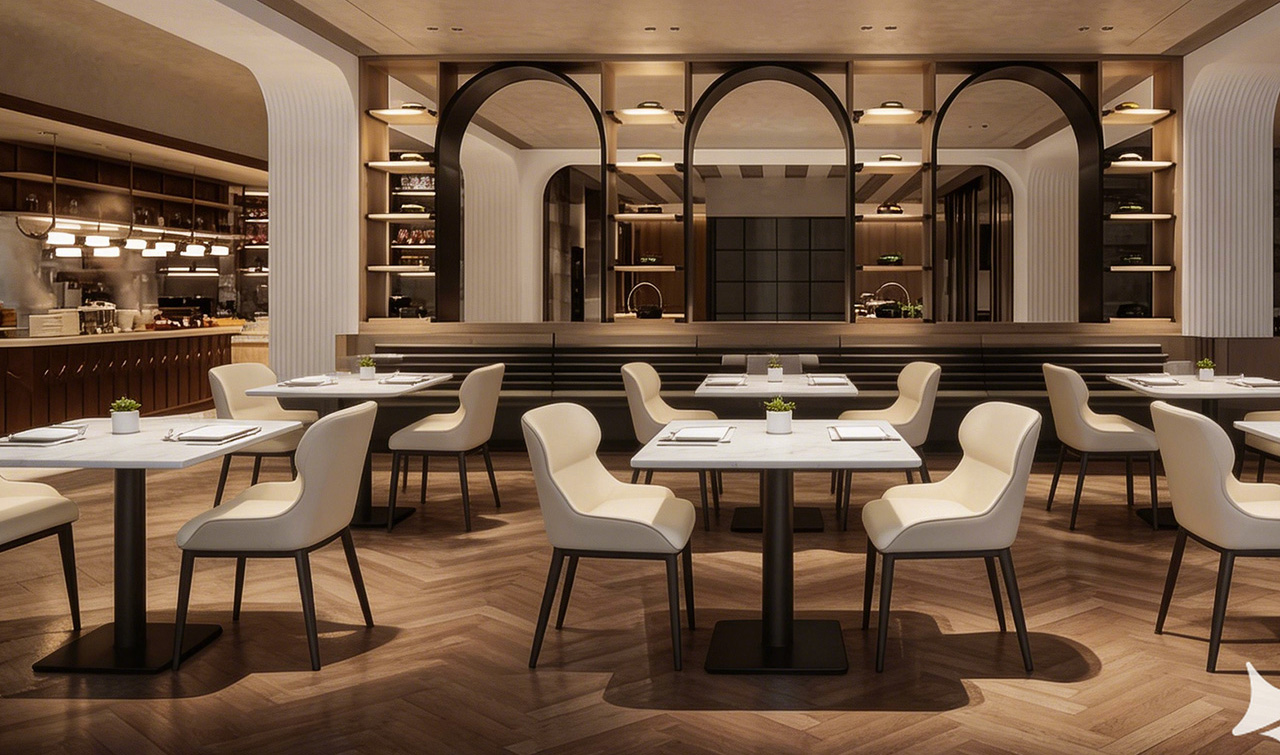
1. Why "Which Material Is Best" Is the Wrong Question
There is no best commercial dining chair material. There is only a best material for a defined zone, an operating intensity and a cleaning regime. Buyers who try to answer the material question globally end up making one of three expensive specification mistakes.
1.1 The mistake of specifying upward
A venue reads that upholstered chairs raise perceived quality, so it specifies fabric seating for the whole floor — including the fast-casual lunch zone and the terrace. Both are wrong places for a fixed fabric chair. In a zone turning tables every 30 to 45 minutes, the seat sees a spill event roughly every second service, and the cleaning routine that a fabric seat requires (spot treatment, extraction, drying time) cannot be performed between turns. The operator either stops cleaning properly — and the chairs look tired inside a year — or pays a cleaning labour premium on every service.
1.2 The mistake of specifying downward
The opposite error: a full-service or fine-dining room fitted with moulded plastic or basic metal seating to save on the capital line. The chairs may survive perfectly well. What suffers is the price the room can carry. Guests read seating material as a signal of the expected check size, and a hard, thin, unadorned seat in a room with a US$45 average cover tells the guest they are in the wrong place. The capital saved on 100 chairs is typically smaller than the revenue impact of a single point of average check across a year.
1.3 The mistake of ignoring the zone
The most common and most avoidable error: treating a multi-zone venue as a single specification. A hotel F&B operation typically contains a breakfast room with 40-minute turns, a lobby café with 90-minute dwell, a bar with standing and perching, and a terrace exposed to weather. These are four different material decisions. Specifying all four as one chair — whatever that chair is — guarantees that at least three zones are wrong.
1.4 The question to ask instead
The workable question is not "which material is best" but "what does this zone do to a chair, and what material survives that treatment while still fitting the room's price positioning?" That question has four inputs, and they are the subject of the next section.
2. The Four Operating Variables That Decide the Material
Before any material is discussed, four operational facts about the zone need to be written down. Each one narrows the material options considerably — and in most real projects the four together leave only one or two viable answers.
2.1 Average dwell time
The average time a guest occupies a seat, measured from sit-down to departure. This single figure determines how much the seat has to work. A chair that holds a guest for 30 minutes needs to look clean and take a wipe; a chair that holds a guest for 100 minutes needs to distribute pressure, support the lower back and stay thermally comfortable.
| Average dwell time | What the seat must do | Material tendency |
| Under 30 minutes | Wipe-clean surface, minimal cushioning, fast reset | Plastic, metal with a wipe-clean pad |
| 30 – 60 minutes | Wipe-clean surface with a thin padded seat; light back support | Metal with padded seat, PU leather on metal frame |
| 60 – 90 minutes | Sustained comfort, back support, credible aesthetic | Upholstered, upholstered metal hybrid |
| Over 90 minutes | Pressure distribution, breathability, lumbar and arm support | Upholstered with high-resilience foam, armchairs |
2.2 Turns per day
Dwell time tells you how long the seat is occupied. Turns tell you how many times per day the chair is vacated, wiped, pushed in, pulled out and sat on again. Turns are the abrasion and cleaning variable — the one that consumes the material.
A chair in a two-turn-per-day à la carte room is reset fewer than 750 times a year. The same seat in a six-turn breakfast room is reset more than 2,000 times. That is a factor of nearly three in both surface abrasion and cleaning cycles, and it is the reason a specification that works in one room fails in another in the same building.
2.3 Cleaning regime
This is the variable most often left out of the specification and the one most likely to determine the winner. There are three practical regimes:
- Damp wipe between turns — a cloth, a food-safe sanitiser, 20 to 40 seconds per chair. Works on sealed, non-porous surfaces: polypropylene, powder-coated steel, aluminium, vinyl, PU leather, coated performance fabric.
- Spot treatment plus periodic deep clean — targeted stain removal after an event, plus scheduled extraction or upholstery cleaning. Works on woven fabric, velvet, chenille, bouclé, genuine leather, and any seat with an open textile surface.
- Full wash-down — hose or pressure cleaning of the whole chair, typical of outdoor terraces, food courts and beach venues. Works only on fully non-porous, UV-stable, drainage-capable construction. Rules out timber, most upholstery and any untreated fastener.
A single chair cannot serve two of these regimes well. If a venue's zones require different cleaning regimes, they require different chairs — this is the structural reason zoned specification exists.
2.4 Exposure
Indoor, semi-outdoor (covered but unheated, or glazed but unconditioned) and full outdoor are three different products. Four factors change: UV dose, moisture and humidity cycling, temperature range, and — in coastal locations — airborne chloride. Each one attacks a different part of the chair. UV degrades plastic and fades coating; humidity swells timber and rusts untreated steel; temperature cycling opens joints; chloride attacks any exposed metal, including fasteners that the frame specification never mentioned.
2.5 The variables combined
Read together, the four variables collapse most specification debates quickly. The combination of short dwell, high turns, damp-wipe cleaning and outdoor exposure admits only plastic and metal. The combination of long dwell, low turns, deep-clean regime and indoor exposure admits only upholstery. The difficult projects are in the middle — 45-minute dwell, four turns, indoor but spill-heavy — and those are the ones the matrix in Section 4 exists to resolve.
3. The Three Materials, Specced Out
The three families are not single materials. Each is a range of constructions with very different performance inside the same label, and the gap between the best and worst example of "a plastic chair" is often larger than the gap between plastic and metal.
3.1 Plastic and resin seating
Three sub-families appear in commercial supply, and they should never be quoted as interchangeable.
Polypropylene (PP). The workhorse of budget commercial seating. One-piece or two-piece moulded shell, moulded-in colour, low unit cost, very light, stacks deep and nests well for freight. Commercial-grade PP chairs should carry a UV stabiliser package and a reinforced leg socket — the leg socket is where an under-engineered PP chair fails, because it concentrates every lateral load into a single moulded boss. Indicative working load for a commercial PP shell is in the 110 to 150 kg range; below that figure the shell is a residential product with a commercial price tag.
Polycarbonate (PC) and glass-filled resin. Higher impact strength, higher stiffness, and a much better-looking edge than PP. Often injection-moulded as a single piece with an integral frame, and capable of working loads in the 200 to 250 kg range. PC takes colour well and holds a smooth finish, which makes it the practical choice where plastic is the right answer but the room cannot accept a cheap-looking shell. The cost penalty over PP is real but modest against the life extension.
Fibreglass and composite shells. Used for moulded seat shells, particularly in designer-led and semi-outdoor applications, and for outdoor chairs where the shell must resist UV without chalking. Cost is closer to upholstery than to PP.
Verification points that matter when you buy plastic: the polymer grade (not just "plastic"), whether UV stabilisation is in the polymer or applied to the surface, the stated static and dynamic load rating, the wall section at the leg socket, and whether the stacking geometry is non-contact — because a stack of PP shells that rests shell-on-shell abrades its own edges in transit and in storage.
3.2 Metal seating
Metal dominates high-turnover commercial dining, and for good reason: it is the only family that combines very high structural durability with a wipe-clean, non-porous surface and full outdoor capability.
Steel tube frames. The standard commercial construction. For dining use, a main frame tube of 25 to 38 mm diameter with 1.2 to 1.5 mm wall thickness is the working range. Below 1.0 mm wall the tube dents on impact and flexes under load; above 2.0 mm the chair gains weight and freight cost with no structural benefit. Joints should be fully welded around the node, not spot-welded — spot welds at the rear leg joint develop hairline cracks under repeated lateral leaning, and the joint that flexes is the joint that eventually wobbles.
Powder coating. The coating is the only barrier between the steel and the cleaning chemicals, food acids and moisture of a working dining room. Film thickness is the number to specify: 70 to 100 μm for indoor commercial use over a properly pre-treated surface, 90 to 120 μm for outdoor or semi-outdoor. Pre-treatment is not optional — a three-stage wash (degrease, rinse, phosphate) is what allows the powder to bond to steel rather than sit on top of oil residue. The practical verification is a cross-hatch adhesion test on a production sample.
Aluminium. Lighter, inherently more corrosion-resistant and the sensible choice for large outdoor programmes where chairs are moved by staff all day. The trade-off is stiffness: aluminium needs a heavier section or a cleverer geometry to match steel, and its welds need proper post-treatment. Do not treat "aluminium" as a synonym for "outdoor-ready" — an untreated aluminium frame in a coastal venue will still pit.
Stainless steel 304. The answer for coastal terraces, wet zones, hot food courts and anywhere a specifier expects chemical cleaning or chloride exposure. Higher unit cost, higher weight, and the correct choice where the alternative is replacing the chairs every second season.
Verification points: tube diameter and wall thickness on the mill certificate, full weld versus spot weld at the load-bearing nodes, coating film thickness in μm, pre-treatment stages, and whether the floor glides are replaceable — a glide is a few cents and a scratched floor is not.
3.3 Upholstered seating
Upholstery buys dwell comfort and perceived quality, and it pays for them in cleaning labour and a shorter replacement cycle. Four specification lines decide whether an upholstered chair survives a commercial room.
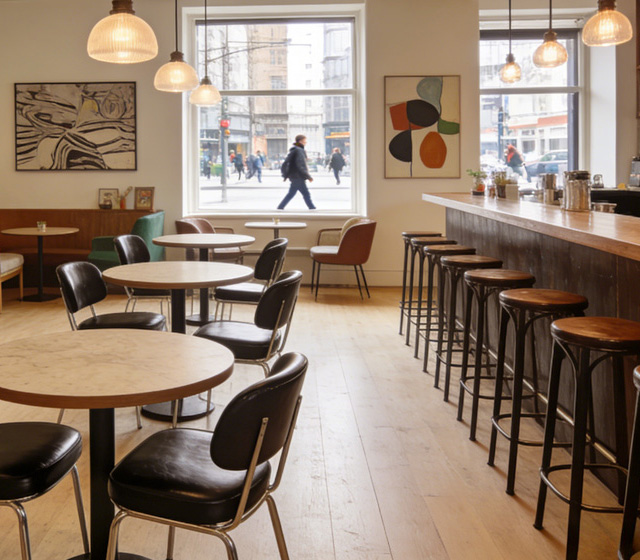
Cover material. The practical commercial options, in ascending order of cleaning difficulty: coated performance fabric and PU leather (wipe-clean, high abrasion), vinyl (wipe-clean, durable, reads as institutional above a certain price point), genuine leather (ages well, needs conditioning, expensive), and natural woven textiles — velvet, bouclé, chenille, linen blends (comfortable and beautiful, and the hardest to keep clean). Natural pile fabrics can be made commercially viable with a short dense pile, a synthetic fibre content and a stain treatment, but they remain a deep-clean product, not a wipe-clean one.
Abrasion rating. The number to request is the Martindale rub count. As a working benchmark: residential dining is typically specified from 20,000 cycles; commercial and contract environments should start at 40,000 cycles, and heavy-duty hospitality — hotel breakfast rooms, 24-hour dining, high-turnover chains — is better served at 60,000 cycles and above. High-performance polyester and coated technical fabrics routinely reach 50,000 to 100,000 cycles; PU leather typically lands in the 30,000 to 60,000 range; untreated velvet and natural weaves often sit below the commercial threshold without treatment. Note that North American specs frequently use the Wyzenbeek double-rub test instead: the two tests are not directly convertible, so a supplier quoting one when you specified the other has not answered the question.
Foam. The specification is density, measured in kg/m³. Commercial seat cushions generally need 30 kg/m³ or above; hotel and fine-dining seating is better at 35 to 45 kg/m³ for the seat and 35 to 38 kg/m³ for the back. Below 30 kg/m³ the seat compresses permanently under daily commercial use and the chair looks tired long before the frame fails. Dual-layer foam construction — a dense structural base under a softer comfort layer — avoids the trade-off between a seat that feels hard from day one and one that feels good for six months and then collapses. Ask also about fire-retardant treatment: for hospitality projects in the UK and EU, BS 5852 Crib 5 or EN 1021-1 / -2 are frequently mandated; in North America, CAL TB 117-2013 is the common reference. These are material- and batch-specific tests, not company-level badges — a supplier should be able to document the treatment and the test report for the specific fabric and foam combination quoted, and a supplier who offers only a certificate for the fabric alone has not certified the chair.
Frame and substrate. Under the upholstery sits the structure. Common constructions are a kiln-dried solid hardwood frame (beech, oak, ash, rubberwood) with mortise-and-tenon joints reinforced by corner blocks, or a plywood shell seat mounted on a metal or timber base. A minimum 12 mm multi-ply substrate with a void-free core is the right base for an upholstered seat; thinner or lower-grade board flexes under load, which makes the foam and fabric above it wrinkle and wear at the stress lines. Movement within a correctly built frame is acceptable and intended; a chair whose joint relies on staples alone is not a contract chair, whatever the cover material.
3.4 The three materials side by side
| Specification line | Plastic / resin | Metal | Upholstered |
| Typical working load | 110 – 150 kg (PP) / 200 – 250 kg (PC) | 150 – 300 kg | 120 – 250 kg, frame-dependent |
| Weight per chair | 3 – 6 kg | 5 – 9 kg | 6 – 12 kg |
| Cleaning method | Damp wipe; full wash-down for outdoor grades | Damp wipe; full wash-down on aluminium and stainless | Spot treatment plus periodic deep clean |
| Clean time per chair | 20 – 40 sec | 20 – 40 sec | 60 sec routine, 5 – 15 min deep clean |
| Stack depth (usable) | 8 – 20+ | 6 – 10 | 0 – 4, often none |
| Typical service life (commercial) | 3 – 6 years | 8 – 12 years | 5 – 8 years frame, shorter cover cycle |
| Indicative FOB unit band | Lowest | Middle | Highest |
| Outdoor suitability | Good with UV stabilisation | Good in aluminium / stainless / marine-grade coating | Poor; outdoor upholstery is a specialised product |
| Perceived quality signal | Low to medium | Medium, design-dependent | Highest |
| Most common failure | UV chalking, leg socket stress crack | Coating wear at contact points, weld fatigue | Foam collapse, fabric abrasion, seam split |
The unit price bands deliberately carry no numbers, because FOB price for a chair is a function of shell weight, tube gauge, coat film thickness, fabric Martindale rating and foam density — the range within each material family is wider than the gap between families. What the table does show is the trade structure: plastic buys capital cost, metal buys service life, upholstery buys dwell comfort and price positioning, and each one is paid for somewhere else.
4. The Selection Matrix
The matrix below maps the operating zones most common in hospitality projects against the three materials, plus hybrid construction — a metal or timber frame with an upholstered pad at the seat only, which is the single most under-used specification in commercial furniture because it captures most of upholstery's comfort at a fraction of its cleaning burden.
Read each cell as a fit judgement for a venue in that zone operating at typical intensity: Best fit means the material matches the zone's dwell, turn count and cleaning regime without compromise; Workable means it can be made to work if the specification is raised in the specific areas noted in Section 5; Avoid means the zone will defeat that material regardless of quality.
| Zone | Plastic | Metal | Upholstered | Hybrid |
| QSR / fast food (<30 min dwell) | Best fit | Best fit | Avoid | Workable |
| Fast casual / canteen | Best fit | Best fit | Avoid | Workable |
| Café / coffee shop | Workable | Best fit | Workable | Best fit |
| Fast-casual bistro (60 min) | Avoid | Workable | Best fit | Best fit |
| Full-service à la carte | Avoid | Workable | Best fit | Best fit |
| Fine dining (>90 min dwell) | Avoid | Avoid | Best fit | Workable |
| Hotel breakfast room | Workable | Best fit | Workable | Best fit |
| Hotel lobby bar / lounge | Avoid | Workable | Best fit | Best fit |
| Banquet / event hall | Best fit | Best fit | Workable | Workable |
| Outdoor terrace / patio | Best fit (UV grade) | Best fit (ALU / SS) | Avoid | Avoid |
| Food court / stadium concourse | Best fit | Best fit | Avoid | Workable |
| Coastal terrace (chloride) | Workable | Best fit (SS 304) | Avoid | Avoid |
Two patterns in this matrix are worth stating explicitly, because they contradict common purchasing instinct. First, metal is the only material that is a best fit in more than half the zones — it is the default answer for volumes, not the compromise option. Second, hybrid construction is a best fit or workable in ten of the twelve zones, which is why it deserves more attention than it usually gets in a specification meeting.
5. The Zones, One by One
The matrix gives the answer. This section explains it, because a specification that cannot be defended in a project meeting is a specification that gets overruled by a design preference.
5.1 QSR, fast food and food courts — under 30 minutes
Everything about this zone is hostile to upholstery. Turns run from four to ten a day; guests eat fast food with their hands and with sauces; the cleaning routine is a wet cloth passed over a whole section in minutes; and the venue's economics depend on reset speed, not on dwell comfort. Longer dwell is actively undesirable here.
The right answer is a one-piece moulded PP or PC shell on a metal or resin base, or a powder-coated steel frame with a formed steel or composite seat. Specify wipe-clean surfaces only, a stack that is stable at 8 to 12 high for overnight consolidation, replaceable glides, and a load rating at or above 150 kg — food court and QSR seating gets treated harshly by guests of all sizes, and an under-rated shell is the most common failure in this zone. Avoid fabric entirely: a woven seat in a QSR is not a premium signal, it is a maintenance liability that the operator will stop maintaining within a quarter.
5.2 Cafés and coffee shops — 30 to 60 minutes, mixed dwell
Cafés are the hardest zone to specify because dwell is genuinely bimodal. The morning commuter trade turns a table in 15 minutes; the afternoon laptop trade holds it for two hours. A single chair has to survive both, and whichever way it is wrong will be visibly wrong for part of the day.
Metal is the safest single answer: a steel or aluminium frame with a padded, wipe-clean seat gives fast-turn guests a clean, light, quick-reset chair and gives longer guests enough cushioning to stay 60 minutes without discomfort. This is the zone where hybrid construction earns its place, because a metal frame with a PU leather or coated-fabric seat pad captures the café's two requirements simultaneously. Keep the pad thin — 25 to 35 mm — so the seat still looks like a café chair rather than a lounge chair, and specify PU at 1.0 to 1.2 mm thickness with a stated abrasion rating so it does not crack at the fold lines. If the café's identity depends on a warm, soft look, upholstered works — but only with a coated performance fabric at 40,000 Martindale or above and foam at 30 kg/m³ minimum, and only if the operator will actually run a spot-clean routine.
5.3 Fast-casual bistros — around 60 minutes
At an hour of average dwell the guest has stopped being a passer-by and started evaluating the room. This is the point at which the material starts to carry price positioning, and it is also the point at which foam density and seam construction begin to matter more than frame strength — because the frame was never the weak point in this zone.
Upholstered or hybrid is the right answer. Specify a padded seat with foam at 35 kg/m³ or above, a cover at 40,000 Martindale minimum, and a frame that is either kiln-dried hardwood with corner-blocked joints or a steel frame with a properly supported seat platform. Where cleaning labour is tight but the aesthetic must read upholstered, the hybrid solution — upholstered seat, metal or exposed timber frame, no upholstered back — reduces the cleaning surface by roughly half while keeping the perceived quality.
5.4 Full-service and fine dining — 90 minutes and above
Dwell comfort is the product here. A guest sitting for two hours needs the seat to distribute pressure, the back to hold a supportive angle (roughly 100 to 105 degrees from horizontal is the range that supports a long meal without encouraging slouching), and the seat surface to breathe. Hard seating in this zone is a mistake so obvious that it is usually avoided — but it is sometimes replaced by a different mistake: a beautiful, low-abrasion fabric that looks correct on opening night and is worn through at the seat front within eighteen months.
Specify upholstery properly: seat foam at 35 to 45 kg/m³, a dual-layer construction, a Martindale rating of 40,000 to 60,000 for a moderate-turn room and above 60,000 for a high-turn or all-day operation, and a fabric whose cleaning tolerance matches the venue's actual routine. Genuine leather ages well and is appropriate where the operator will run a conditioning programme; PU leather and coated performance fabric are more forgiving where cleaning will be improvised. Backrest construction matters as much as the seat: an upholstered back panel must be mechanically fastened to a frame, not stapled to a thin shell that will flex and crack the cover at the corners.
5.5 Hotel breakfast rooms — high turns, short dwell, brand-sensitive
The breakfast room is the most demanding upholstery environment in a hotel, and the one most often specified by aesthetic default. Turns run three to six per morning, dwell is 30 to 45 minutes, spills are constant and the room has to look immaculate at 06:30 every day for years. Meanwhile the brand standard may require an upholstered look.
The workable resolution is a metal or timber frame with a wipe-clean padded seat and a minimal upholstered back, or a fully upholstered chair specified at the top of the range — foam at 35 kg/m³ and above, coated performance fabric at 50,000 Martindale or above, and ideally a removable or replaceable seat pad so that a damaged cover is a repair rather than a chair replacement. The seat pad is the part that wears; making it serviceable turns a five-year replacement cycle into a ten-year one at very little cost.
5.6 Hotel lobby bars and lounges — long dwell, low turns, high expectation
Upholstered, without argument. Dwell here can exceed two hours, turns are fewer than two a day, and the seating is a brand asset that is photographed and reviewed. Specify for comfort and appearance: high-resilience foam at 35 to 45 kg/m³, arm support where the layout allows, a cover chosen for how it will look in three years rather than on opening night, and fire treatment documentation appropriate to the jurisdiction (BS 5852 Crib 5 or EN 1021 in the UK and EU, CAL TB 117-2013 in North America).
5.7 Banquet and event halls
Banquet seating optimises for volume, speed of changeover and storage, not for dwell — even though guests do sit for long periods. The industry answer is a lightweight stackable chair, most commonly an aluminium or steel frame with an upholstered seat pad and back panel, stackable to a substantial height and usually moved on trolleys. This is functionally a hybrid construction built for throughput.
Specify stack stability rather than maximum stack height (the height at which the stack still resists a light lateral nudge is the real number), contact-point protection so that stacked chairs do not abrade each other's upholstery, trolley-compatible footprints confirmed against the venue's actual trolleys, and a correct fire performance rating, which for public assembly seating is non-negotiable in most jurisdictions.
5.8 Outdoor terraces and patios
Outdoor is not indoor seating placed outside. Four things change and all four are specification lines. The coating or material must handle UV and rain — polypropylene with UV stabilisation, powder-coated aluminium, or stainless steel. Fasteners must be stainless or corrosion-protected; this is the most frequently overlooked line in an outdoor specification, and the frame usually outlives the screws. Seats must be non-porous and drainage-capable, with sealed tube ends, because an open tube collects water, rusts from the inside and splits when it freezes. And the whole assembly must tolerate a wash-down cleaning regime rather than a wipe.
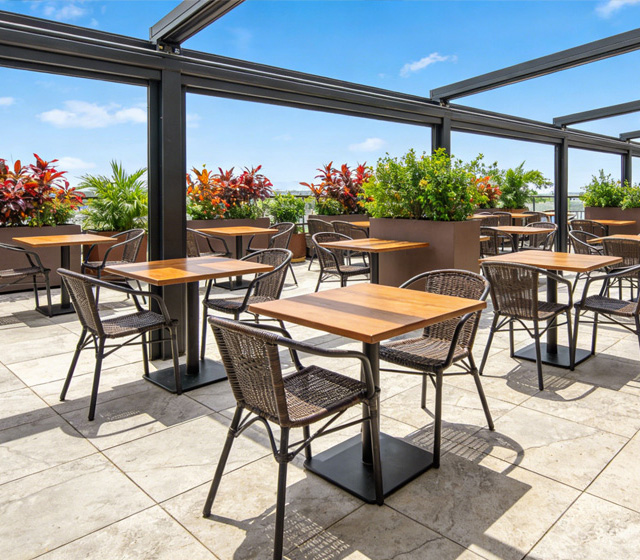
Fabric upholstery does not belong on an uncovered terrace. Where an outdoor cushion is required, it is a specialised quick-dry, mould-resistant product with a removable cover — a different purchase from indoor upholstery, and one that should be budgeted and replaced on its own cycle.
5.9 Coastal terraces and poolside
Add airborne chloride to everything in 5.8 and the answer narrows to stainless steel 304 or a marine-grade coated aluminium frame with stainless fasteners, with a plastic or composite shell. Chloride attacks any exposed ferrous metal, including the fasteners, hinges and glides that a frame-only specification never mentions. Where salt-spray resistance is a project requirement, request the test result in hours — 48, 240 and 500 hours are the common benchmarks — and match the target to the venue's distance from the water rather than accepting a generic claim.
6. How Each Material Actually Fails
Buyers evaluate chairs by how they look new. Chairs are replaced because of how they fail. Knowing the characteristic failure mode of each material is the fastest way to write a specification that addresses the real risk — and the fastest way to tell a good sample from a good product.
6.1 Plastic fails at the leg socket and in the sun
Two failures dominate. The first is stress cracking at the leg socket: every lateral load on the chair — a guest shifting weight, a chair dragged across a floor, a stack being pushed — concentrates at the point where the leg meets the shell. If that joint is a single moulded boss in a thin section, it develops a crack, the crack propagates, and the chair becomes unsafe without ever looking broken. The second is UV degradation: unstabilised polypropylene chalks, fades and embrittles over one to three summers of direct sun, after which the shell cracks under normal load. Coloured products fade faster than natural ones if the pigment is surface-applied rather than moulded in.
Both failures are specification problems, not quality accidents. Ask for the wall section at the leg socket, the load rating, and whether UV stabilisation is compounded into the polymer.
6.2 Metal fails at the coating, then at the weld
The steel itself rarely fails first. Coating wear at the contact points does: wherever two chairs touch during stacking, or wherever a chair contacts a table edge, the powder film abrades. Once the film is breached, corrosion begins at that spot and creeps under the surrounding coating, lifting it. This is why contact-point protection and non-contact stacking geometry matter more than the label on the coating. The second failure is weld fatigue at the loaded nodes — the rear leg joint above all — where spot welds crack under repeated lateral loading and the joint develops the characteristic flex that gets a chair pulled off the floor.
Both are addressable in the specification: film thickness in μm, pre-treatment stages, full versus spot weld, and contact-point design.
6.3 Upholstery fails at the foam first, the fabric second, the seam third
Three failure modes run in a predictable sequence. First foam collapse: below 30 kg/m³ density, the seat compresses permanently under commercial use and develops a dished profile within twelve to twenty-four months, which then makes the cover above it wrinkle and wear unevenly at the stress lines. Second fabric abrasion: the seat front and the backrest crown are the contact zones, and a fabric below the commercial rub threshold shows pile loss, pilling or shine at those points long before it tears. Third seam failure, usually at the seat front where the cover meets the frame rail, accelerated by a substrate that flexes — which is why a 12 mm void-free multi-ply seat base is a durability specification, not a cost line.
The fourth upholstery failure is the one operators cause themselves: stopping the cleaning routine. A fabric chair that was correctly specified for a damp-wipe-and-spot-treat regime, then wiped with a wet cloth and left to dry repeatedly, will fail at the seams and develop odour long before its abrasion rating is exhausted.
7. The Cleaning Labour Cost Nobody Models
Cleaning is the largest hidden cost difference between the three materials, and it almost never appears in the purchasing comparison — because the chairs are bought by a procurement team and cleaned by an operations team, and the two budgets are not read side by side.
7.1 The arithmetic
Take a 100-seat venue running 200 covers a day. The seat is wiped after every turn, so the cleaning event count is roughly the cover count. The difference between materials is the time per event.
| Material | Time per routine clean | Annual hours at 200 covers/day | Deep-clean burden |
| Plastic | 20 – 30 sec | ≈ 1,100 – 1,700 | Negligible |
| Metal (wipe-clean) | 20 – 40 sec | ≈ 1,100 – 2,200 | Negligible |
| Upholstered (spot regime) | 45 – 90 sec | ≈ 2,500 – 5,000 | Scheduled extraction, 2 – 4 times a year |
At any reasonable fully-loaded labour rate, the difference between a 30-second and a 75-second clean across 200 daily covers is a five-figure annual sum. Over a five-year ownership period, that difference alone can exceed the entire capital cost of the chairs.
7.2 What follows from the arithmetic
Two practical conclusions. First, in any zone above roughly four turns a day, the cleaning labour penalty on fabric seating usually outweighs its comfort advantage — which is why the matrix sends fast-turn zones to plastic and metal regardless of aesthetics. Second, where a venue genuinely needs upholstery in a wipe-clean zone, the specification that resolves the conflict is the hybrid: upholstered where the guest contacts the chair, wipe-clean everywhere else. Every square centimetre of fabric removed from a chair is a recurring saving, not a one-off one.
8. Five-Year Total Cost of Ownership
Unit price comparisons between these materials are close to meaningless, because the materials do not have the same service life and do not consume the same operating budget. The number that supports a decision is cost per usable chair-year.
8.1 The model, worked through
Take a 100-seat venue and compare three chairs over five years at the same seat count. Prices are indexed rather than quoted, because actual FOB price depends on specification within each family.
| Line item | Plastic (PP, commercial grade) | Metal (powder-coated steel) | Upholstered (coated fabric) |
| Unit price index | 100 | 165 | 230 |
| Expected service life | 3 – 5 years | 8 – 12 years | 5 – 7 years |
| Replacements over 5 years | 1 (partial) | 0 | 0 – 1 (cover or pad) |
| Capital over 5 years (index) | 100 – 140 | 165 | 230 – 270 |
| Cleaning labour over 5 years (index) | 100 | 110 | 220 – 340 |
| Maintenance / parts | Glides | Glides, occasional recoating | Pads, covers, deep cleaning |
| Downtime / guest-facing risk | Mid-cycle visible ageing | Lowest | Highest if cleaning slips |
| Indicative 5-year total (index) | 200 – 240 | 275 | 450 – 610 |
The two conclusions this model supports are the ones that most often surprise buyers. First, commercial-grade metal is frequently the cheapest option over five years — not because the chair is cheap, but because it does not get replaced and does not consume a cleaning premium. Second, upholstery's total cost is dominated by its operating cost, not its purchase price. Upholstery is not expensive because the chair costs more; it is expensive because the room has to clean it.
8.2 When the upholstery premium is still correct
None of this argues against upholstery. In the zones where dwell time carries the venue's price positioning — fine dining, hotel lounges, upscale bistros — the revenue effect of the seating materially exceeds the operating premium, and the upholstery cost is a marketing investment with a defensible return. The error is not buying upholstery; it is buying it for zones whose economics cannot carry it, and then cutting the cleaning routine to compensate.
9. Zoned and Hybrid Strategies
Because the answer differs by zone, the correct specification for a multi-zone venue is almost never one chair. It is a small number of chairs, each mapped to a zone, deliberately coordinated so that the room still reads as one design.
9.1 The zoning method
Map the floor into zones by the four variables from Section 2, not by aesthetics. A typical full-service venue of 120 seats resolves into three or four zones: a high-turn lunch section, a longer-dwell dining section, a bar or perch area, and possibly a terrace or private room. Each zone gets the material its operating profile demands, and the coherence of the room comes from a shared palette and silhouette language rather than from using one identical chair everywhere.
9.2 A worked zoning example
| Zone | Seats | Dwell / turns | Specification |
| Lunch / quick section | 40 | 30 – 45 min / 4 – 6 turns | Metal frame, formed or composite seat, wipe-clean |
| Main dining room | 50 | 75 – 100 min / 1.5 – 2 turns | Upholstered seat and back, 35 kg/m³ foam, 40,000+ Martindale |
| Bar / perch | 20 | 30 – 60 min / mixed | High stool, metal frame, padded wipe-clean seat |
| Terrace (seasonal) | 30 | 45 – 90 min / weather-dependent | Aluminium or UV-stabilised PP, wash-down, stackable |
This configuration uses three constructions and one shared design language. It costs less to run than an all-upholstered floor, performs better than an all-metal floor, and — critically — allows the operator to replace the terrace chairs on their own cycle without touching the dining room. A single unified specification cannot do any of these things.
9.3 The hybrid construction in detail
Hybrid seating — a structural frame of metal or timber with an upholstered seat pad, and either a hard or a padded back — deserves the attention it gets in the matrix because it occupies the middle ground that most venues actually need. It delivers the pressure relief of a padded seat, which addresses the comfort complaint that drives guests away from hard seating, while keeping the back, frame and outer surfaces wipe-clean, which removes the majority of the cleaning burden. It is also easier to repair: a worn pad is a part, not a chair.
Specify it as: frame in the material your zone requires, seat pad at 30 to 40 mm with foam at 30 kg/m³ and above, cover in PU leather or coated performance fabric at 1.0 to 1.2 mm, and a fixing method that allows the pad to be removed for replacement without disassembling the frame.
10. Specifications to Send a Supplier
The three lists below are written to be sent as-is in an RFQ. Each line is a variable that changes the product, and each is verifiable on a sample or a certificate.
10.1 Plastic and resin chairs
- Polymer grade: polypropylene, polycarbonate, glass-filled resin or fibreglass composite — stated by name, not "plastic"
- UV stabilisation: compounded into the polymer or surface-applied; state the expected outdoor service window
- Load rating: static and dynamic, in kg, for the specific model
- Wall section at the leg socket, and the reinforcement method used there
- Colour method: moulded-in or surface-applied
- Stacking: usable stack height, and whether stacking is contact or non-contact
- Outdoor variants: drainage provision, sealed ends, UV pigment stability
- Glides: replaceable, and the replacement part number
10.2 Metal chairs
- Frame tube: diameter and wall thickness in mm, confirmed on the mill certificate
- Joint method: full weld or multi-pass at load-bearing nodes, ground flush before coating
- Coating: powder film thickness in μm, and the number of pre-treatment stages
- Adhesion verification: cross-hatch test result on a production sample
- Outdoor specification: salt-spray resistance in hours, and stainless or corrosion-protected fasteners
- Seat: formed steel, composite, plywood or padded — with the substrate thickness stated
- Stack: tested stable height, contact-point protection type, trolley compatibility
- Glides: replaceable, specified material, and spare part availability
10.3 Upholstered chairs
- Cover material and composition, with a physical swatch approved before production
- Abrasion: Martindale rub count (or Wyzenbeek double rubs) to ISO 12947-2 / ASTM D4157, with the test certificate
- Foam: density in kg/m³ for seat and back separately, and single-layer or dual-layer construction
- Substrate: seat base material and thickness, minimum 12 mm void-free multi-ply
- Frame: species, kiln-dried, joint type (mortise-and-tenon, dowel, corner-blocked), and whether staples alone are used anywhere structural
- Fire performance: the applicable standard for the destination market — BS 5852 Crib 5 or EN 1021 for UK and EU projects, CAL TB 117-2013 for North America — documented per quoted material and batch
- Serviceability: whether the seat pad or cover can be replaced as a part
- Cleaning instruction supplied in writing, matched to the fabric actually quoted
11. Freight: The Material Difference Nobody Budgets
The three materials load very differently into a container, and on a landed-cost basis this can move the comparison as much as unit price.
| Material | Loading behaviour | Freight effect |
| Plastic / resin | Stacks deep and nests; low weight per unit | Lowest freight per chair |
| Metal | Stacks at 6 – 10; moderate weight | Moderate; weight can become the constraint |
| Upholstered | Does not stack; bulky, crush-sensitive | Highest per chair; volume typically the limit |
Two practical implications. First, for upholstered chairs that do not stack, knock-down construction — legs or base shipped detached and assembled on arrival — can improve container utilisation substantially, at the cost of assembly labour and a small risk of missing hardware; it suits large projects with on-site assembly capability rather than small distributors. Second, an order that does not fill a container should be mixed: chairs co-loaded with table tops, table bases or a second chair model reduce per-unit freight significantly. Confirm with the supplier whether mixed containers are accepted across product lines before the order is placed, not after.
12. Frequently Asked Questions
Which material is best for a restaurant with mixed dining zones?
Specify by zone rather than by venue. A quick-turn lunch section is best served by metal or plastic; a longer-dwell dining room by upholstery or hybrid. Use a shared palette and silhouette so the room still reads as one design. A single material across all zones will be wrong in at least one of them.
Is plastic seating acceptable in an upscale venue?
Not as the primary dining chair in a fine-dining or premium room. Plastic reads as a value signal, and in a room whose average check depends on a quality perception, moulded resin seating works against the positioning. Where plastic is used in an upscale context, it belongs on terraces, in back-of-house and in casual or overflow zones.
How long should commercial dining chairs last?
Indicative working figures: commercial-grade plastic shells 3 to 6 years, powder-coated steel frames 8 to 12 years, upholstered chairs 5 to 7 years with an upholstery or pad replacement cycle inside that. Service life is set by the weakest specified component, not by the frame — the most common reason a chair is replaced early is foam collapse or fabric wear, not structural failure.
What Martindale rating do I need for restaurant upholstery?
Commercial and contract seating generally starts at 40,000 cycles, with heavy-duty hospitality — hotel breakfast rooms, all-day dining, high-turnover chains — better served at 60,000 and above. Residential fabrics, often 15,000 to 25,000 cycles, will not hold up in a commercial room. Where a North American spec calls for Wyzenbeek double rubs instead, the two figures are not directly convertible, so confirm the test used and the certificate.
What foam density should a commercial dining chair use?
30 kg/m³ is the effective commercial floor for seat cushions; 35 to 45 kg/m³ is appropriate for hotel and fine-dining seating, with the back typically 35 to 38 kg/m³. Below 30 kg/m³ the seat compresses permanently under daily use and the chair visibly ages within a year.
Do upholstered dining chairs need fire-retardant treatment?
It depends on the destination market and the occupancy. UK and EU hospitality projects frequently mandate BS 5852 Crib 5 or EN 1021-1 / -2; North American projects commonly reference CAL TB 117-2013; public assembly and banquet seating is typically regulated regardless of region. The test applies to the composite — cover fabric, interliner and foam together — not to the fabric alone, so request documentation for the specific combination quoted rather than a fabric-only certificate.
Can metal chairs be comfortable enough for a long meal?
With a properly specified padded seat, yes. A steel frame with a 30 to 40 mm PU or coated-fabric pad at commercial foam density handles a 60 to 90 minute meal comfortably. Bare metal or a thin hard seat is not appropriate for long dwell. The hybrid steel-frame construction is the standing answer to this question.
What is the best chair for an outdoor terrace?
Non-porous, UV-stable and wash-down capable: UV-stabilised polypropylene, powder-coated aluminium or stainless steel, with stainless fasteners, sealed tube ends and drainage provision. Indoor upholstery should not be used on an uncovered terrace; where an outdoor cushion is required it is a specialised quick-dry product on its own replacement cycle. Coastal sites should specify stainless 304 as a minimum, with a stated salt-spray resistance figure.
How do I verify quality before placing a volume order?
Request and physically check: the mill certificate for tube diameter and wall thickness; the coating film thickness in μm and the pre-treatment stages; the fabric's Martindale or Wyzenbeek certificate; the foam density in kg/m³; the seat substrate thickness; and whether load-bearing joints are fully welded or mechanically reinforced. Weigh a sample against the stated weight, and apply firm pressure to the centre of the seat to feel for flex in the substrate. A supplier who cannot produce these answers is quoting from an assumption.
Can one supplier cover all three materials and the full seating package?
Yes, and for multi-zone venues it is often the better commercial arrangement, because it keeps the palette and construction standards consistent across zones and consolidates freight into mixed containers. The trade-off is that not every factory works across all three families — confirm which materials are produced in-house and which are sourced, since it affects lead time and quality control.
13. Choosing the Right Commercial Dining Chair
The material question resolves once the operating question is answered. Write down the zone's average dwell time, its turns per day, its cleaning regime and its exposure — four facts that take ten minutes to establish and that remove most of the specification risk. Match those four inputs to the matrix, raise the specification in the areas this guide flags for that zone, and validate the result against a five-year cost per usable chair-year rather than a unit price.
Two rules survive every project. Metal is the default for high-volume, high-turn and outdoor zones, and it is the material that most often wins on total cost. Upholstery is the default for zones where the seating carries the room's price positioning, and it should be bought only where the operating budget can carry the cleaning routine it requires. Everywhere in between, hybrid construction is the most under-specified answer in commercial furniture, and it deserves a place in the first draft of the plan rather than the third revision.
Where AEONTI fits
AEONTI manufactures commercial table systems and seating from our Foshan facility, covering the three families discussed here — metal frames, moulded resin, and upholstered chairs built on steel, aluminium or kiln-dried hardwood frames. Standard MOQ is 100 sets per design, standard lead time is 25 to 30 days, and orders can be mixed across product lines — chairs co-loaded with table bases and table tops in a single container — so a multi-zone venue can specify in one place rather than three.
Every upholstered specification is quoted with the cover material, Martindale rub count, foam density and substrate thickness stated on the quotation, and fire-retardant treatment is available on request with the test documentation for the specific material and batch quoted. We do not present a company-level certification as a substitute for a per-order test report; if a project requires documented fire performance, that documentation is supplied with the order.
For specifiers and project buyers, the practical route is to send the zone list and the four variables, and receive a constructed proposal per zone with the specification lines already filled in. Custom OEM work is available from sketch or drawing, including bespoke frame geometry, fabric and finish matching to a project palette, and private-label programmes.
Written by Zoey — AEONTI