Which Table Base Styles Will Be in Demand in 2027? 8 Trends for Commercial Buyers
- Share
- publisher
- AEONTI
- Issue Time
- Nov 12,2026
Summary
Which table base styles will commercial buyers actually re-order in 2027? This guide walks through eight directions - pedestal, cross, sculptural, black, material mix, one-platform, modular and custom table bases - then maps each material to its best use scenario, lists eight failure conditions that turn a good-looking base into dead stock, and gives the four base types plus seven supplier questions to lock before you place the PO.
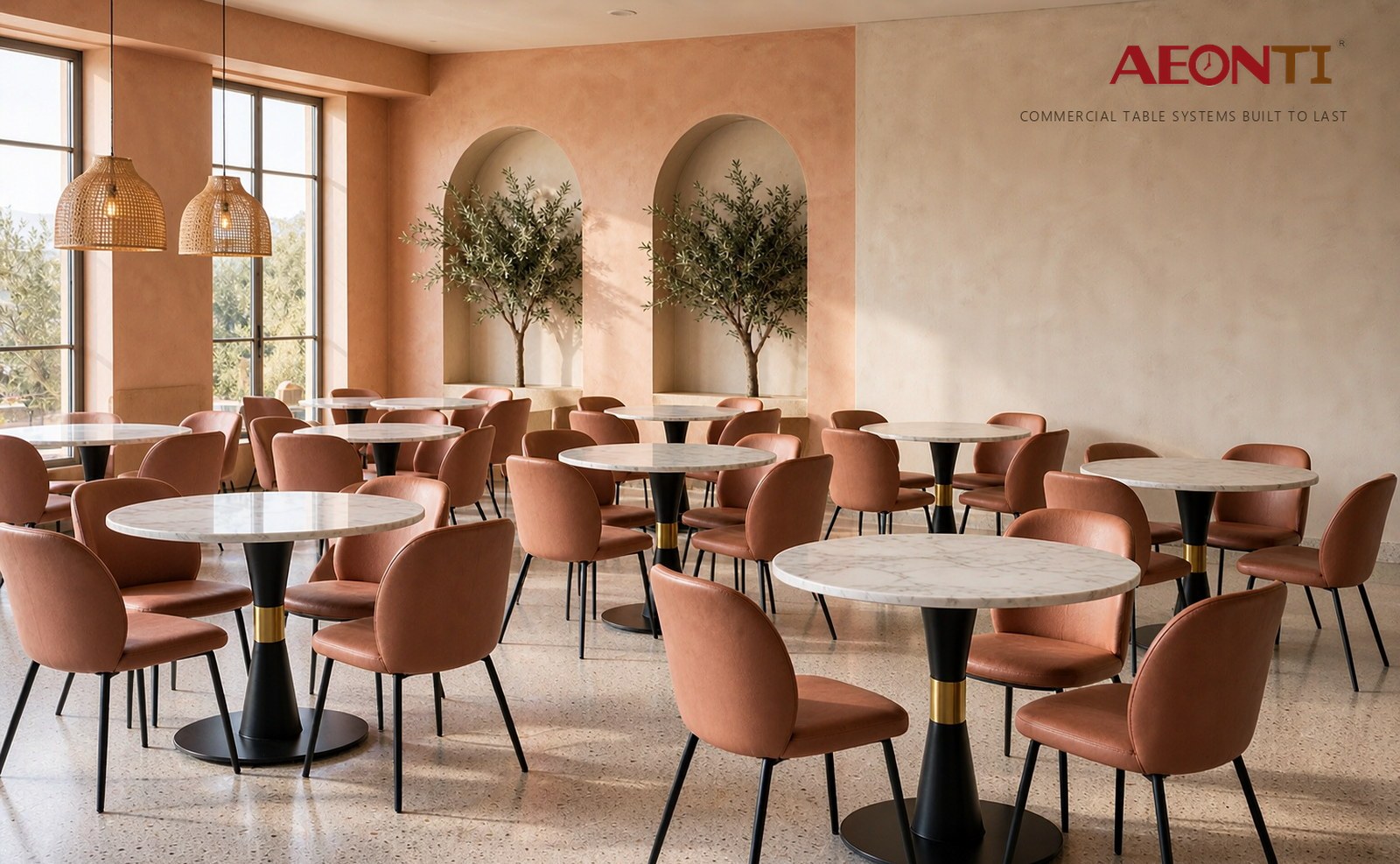
2027 Outlook — Trend Dossier
Which Table Base Styles
Will Be in Demand in 2027?
Eight directions worth planning for before the season starts — written for furniture wholesalers, restaurant furniture distributors, brand buyers and the people who specify bases for hotels, restaurants and cafes.
If you are a furniture wholesaler, a restaurant furniture distributor, a buyer for a furniture brand, or you are sourcing metal table bases for hotels, restaurants and cafes right now, there is a question that deserves more of your attention than the obvious one.
Not “which base sells best today” — but which table base styles are worth planning for in 2027?
A table base looks like nothing more than a structural part under a table top. For commercial furniture buying it decides a great deal more: how the table looks, how stable it is, how much legroom a guest gets, how many seats fit into a room, how efficiently the product ships — and, in the end, the price the finished table can be sold at.
More importantly, the 2027 trend will not point to one single hit base. What is genuinely worth watching is that design, commercial performance, flexibility and customisation are starting to merge into the same product.
Restaurant furniture trends of recent years already show it: restaurants and commercial interiors keep pushing for flexible layouts, durability, comfort and a visual design you can recognise from across the room.
So the useful question for a buyer is not “what is popular?” but “what should I commit to before everyone else does?”
Waiting until the market has already moved and then hunting for a supplier is the expensive version of this decision. Thinking it through now is the cheap one. What will the next batch of table bases worth stocking actually look like?
The shift
In 2027, a table base may stop being just “the thing that holds the top up”
In the past, most buyers picked a base on three parameters: can it carry the load, what does it cost, and is it in stock. Those three questions have not disappeared — they have become the entry ticket rather than the brief.
The market is moving because more and more restaurants, hotels, cafes and commercial furniture brands now treat the base itself as part of the design, not as a component hidden under a top. Some 2027 forecasts already show the signal clearly: dining tables are shifting from ordinary functional furniture to the visual focus of a space, and bases with a sculptural, architectural or clearly structural character are drawing the attention.
The good base of the future is not necessarily the most complicated one. It is the one that solves “looks good, works well, sells well, buys well” at the same time.
| The old three questions | What a 2027 buyer asks instead | What it changes for the supplier |
|---|---|---|
| Can it carry the load? | Will it hold an 800 mm stone top without a wobble after two years of service? | Load data has to be documented, not claimed |
| What is the price? | What is the landed cost per set, and what does the foot cost me in chair positions? | Freight, packing density and plate size enter the quotation |
| Is it in stock? | Can I re-order the same finish and the same tolerance in eight months? | Finish control and repeatability matter more than a sample |
So which types deserve close attention? Eight of them, in the order we would plan them.
Trend One · Signal: very strong
Simple, but recognisable: the pedestal table base
If we had to predict one direction for the commercial dining table market in 2027, it would be this: pedestal table bases.
Why? Because commercial dining space increasingly has to use a limited floor area flexibly. Traditional four-leg bases are stable, but the legs take up space under the top, get in the way of a guest’s legs and limit where chairs can be placed.
A suitable pedestal base concentrates the support structure in the centre of the top and gives guests the space under the table back. For a room that is measured in covers, that is not a detail — it is capacity.
- Restaurants
- Cafes
- Hotel dining areas
- Bistros
- Bars & lounges
- Small commercial dining rooms
The advantage goes further than legroom. A pedestal base can be paired with round, square and even some special-shape tops, which means one base series can carry several table top products. For a distributor that is a portfolio decision, not a design preference: one platform, four catalogue pages.
That is why the pedestal is both a design trend and a product-mix strategy — and why it is the first thing we would put into a 2027 range. The trade-off against four-leg frames is covered in our comparison of base design and seating capacity.
The pedestal wins wherever floor area is the constraint and the top has to change shape without changing the base.
Trend Two · Signal: strong
Cross base — a classic structure, redesigned
If the pedestal is about space efficiency, the cross base and X base are about something less exciting and more profitable: not dating.
For a wholesaler, the product genuinely worth selling long term is rarely the most dramatic one. It is the one that adapts to different customers — the base that levels on a bad floor, packs flat, accepts a round or square top and still looks current in year five.
- Restaurant tables
- Cafe tables
- Bistro tables
- Hotel dining tables
- Commercial dining areas
And the same structure produces a completely different visual result depending on material, size and finish. That is the real reason this shape keeps selling: one geometry, several price bands.
| Version | Material | What it reads as |
|---|---|---|
| Industrial / modern | Iron cross base | Weight, matte black, warehouse-loft language |
| Contemporary / premium | Stainless steel cross base | Brushed or polished surface, hotel lobby read |
| Lightweight / outdoor | Aluminium cross base | Half the freight, coastal and terrace use |
So for a volume buyer the advice is simple: do not buy one beautiful base. Buy a series that can be produced in different sizes, materials and finishes, and let the cross base be the low-risk anchor of that series. Bulk programmes run better on the cross-shape base than on any statement piece.
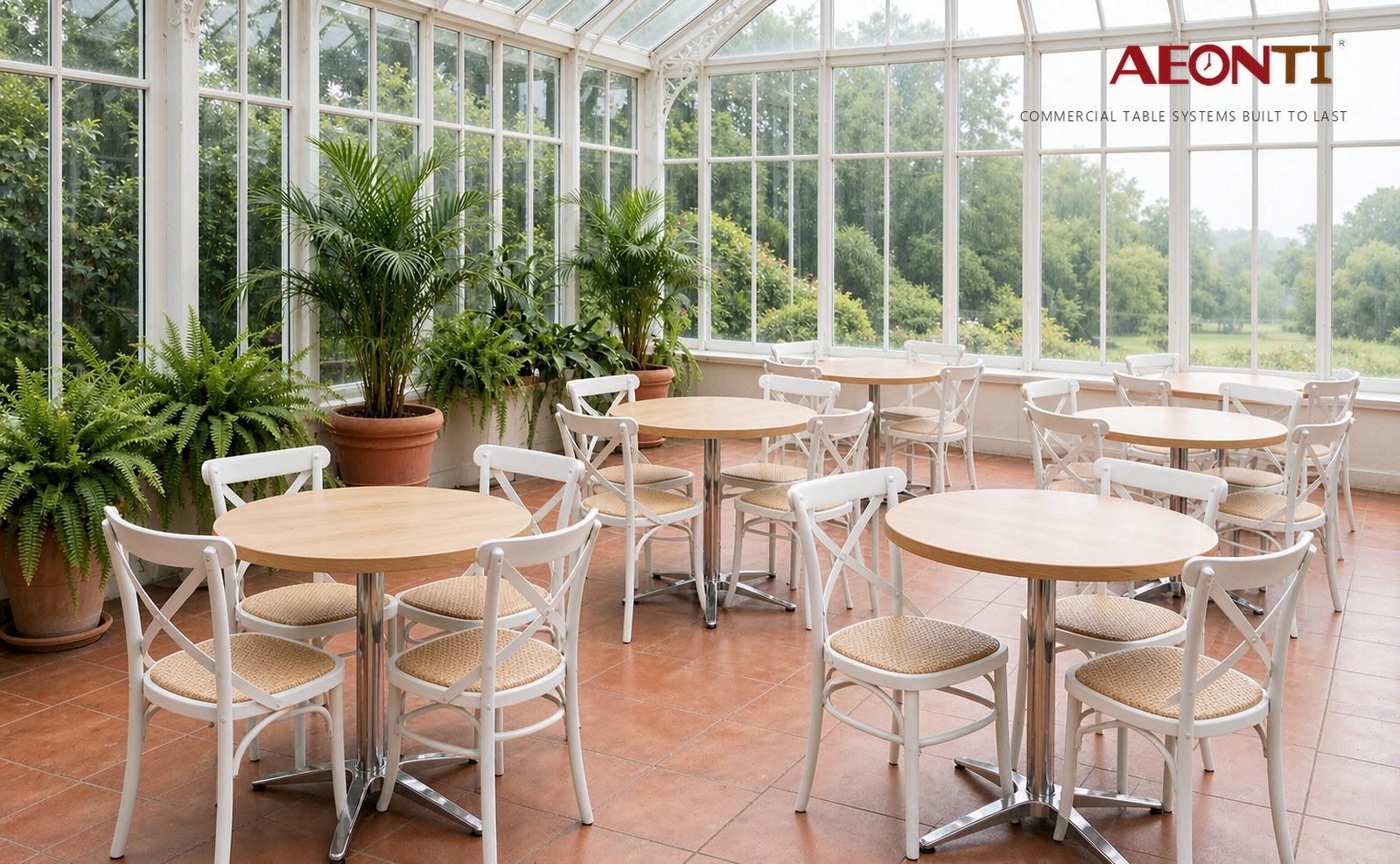
Trend Three · Signal: rising fast
Sculptural bases — the base becomes the selling point
This is the change most worth noting for 2027. The old equation was base = structure, top = design. The new one is base = design language.
More and more dining tables now use a pronounced base shape: a large-volume plinth, a geometric frame, an architectural form, a centre support with real visual weight. Some 2027 furniture forecasts put “sculptural bases” directly on the list of important directions for dining table design.
For furniture brands this matters more than for anyone else. When products become homogenised, a top is copied in a week — a base with a recognisable identity is not. An ordinary wooden top on ordinary four legs is just a table. The same wooden top on a distinctive metal base becomes a product family.
Two commercial cautions come with it. Volume: a heavy sculptural base can cut container density by a third if the packing plan is written after the shape. Repair: powder coat on a complex profile is harder to touch up than on a flat plate, so a matte textured finish is more forgiving than gloss. The black and brass square base sits in the middle of that trade-off — strong silhouette, simple surfaces, two finishes instead of five.
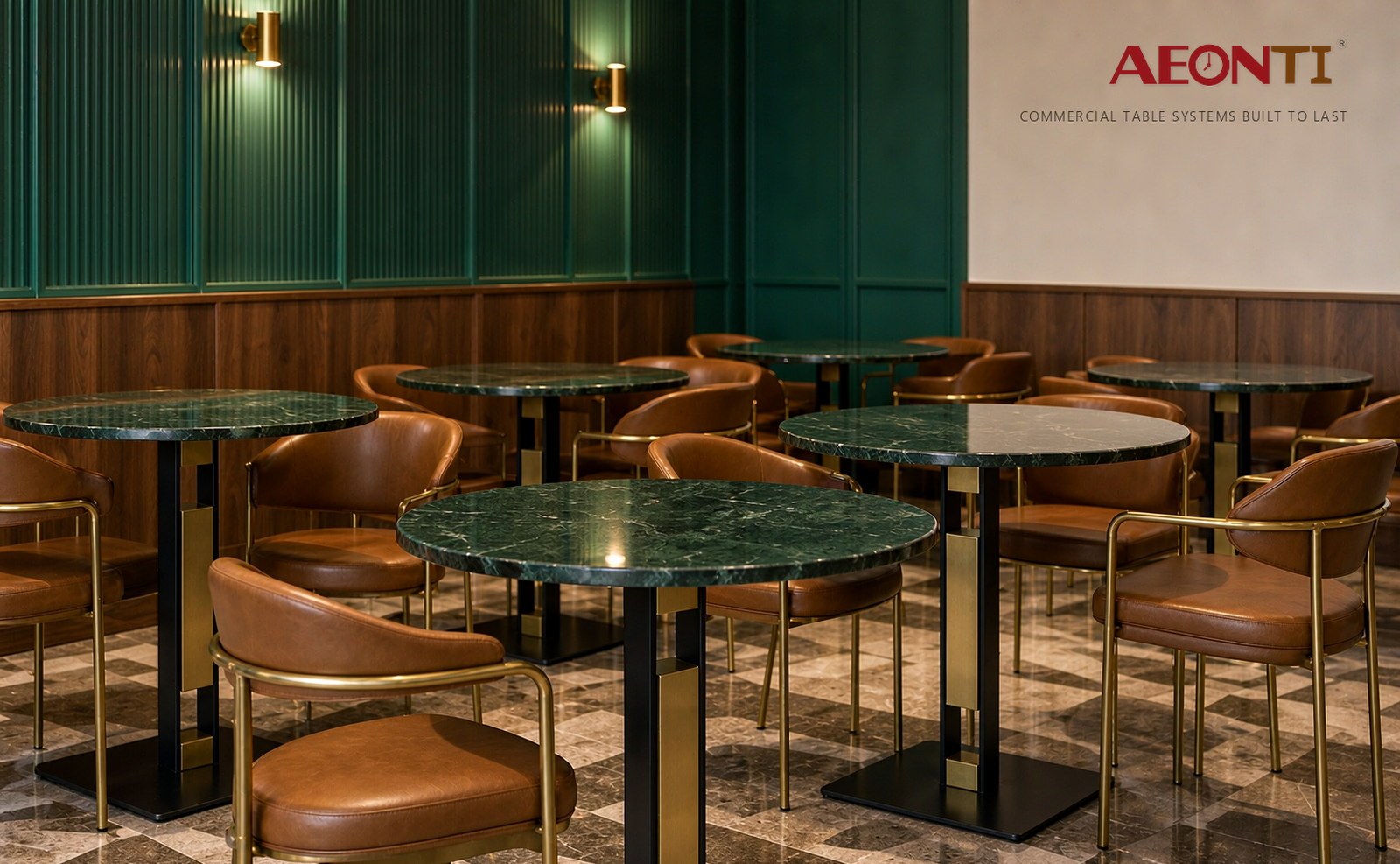
Not “how much is this base?” but “can this base become the selling point of my product?” A conical project base answers the second question; a commodity cylinder does not.
The durability side of the same argument is set out in durability meets design — a sculptural shape only earns its price if the finish survives trolley traffic.
Trend Four · Signal: strong
Black metal bases will still sell — but “plain black” may not be enough
Every year somebody forecasts the end of black. It has not happened, and it will not happen in 2027 — because for commercial furniture, classic products do not disappear.
Black is the most compatible finish on the market. It sits acceptably on table tops in wood, HPL, sintered stone, artificial marble, dark surfaces and pale surfaces at the same time. Compatibility is a commercial feature, and no colour has more of it.
What does change is the design and the texture behind the colour. Matte black is no longer a specification; it is a starting point. Buyers are moving to black powder coating with a fine texture, black plus a wood section in the column, black with a bronze or brass detail for premium rooms.
The guest still sees a black table. The buyer is purchasing a different product: a black commercial base with more texture, more stability and a better fit with the brand’s visual identity.
This is also where price positioning happens without new tooling. The same silhouette in three finishes occupies three price points in one catalogue — entry, middle, premium — which is why we keep all three live on the metal table base line rather than treating black as one SKU.
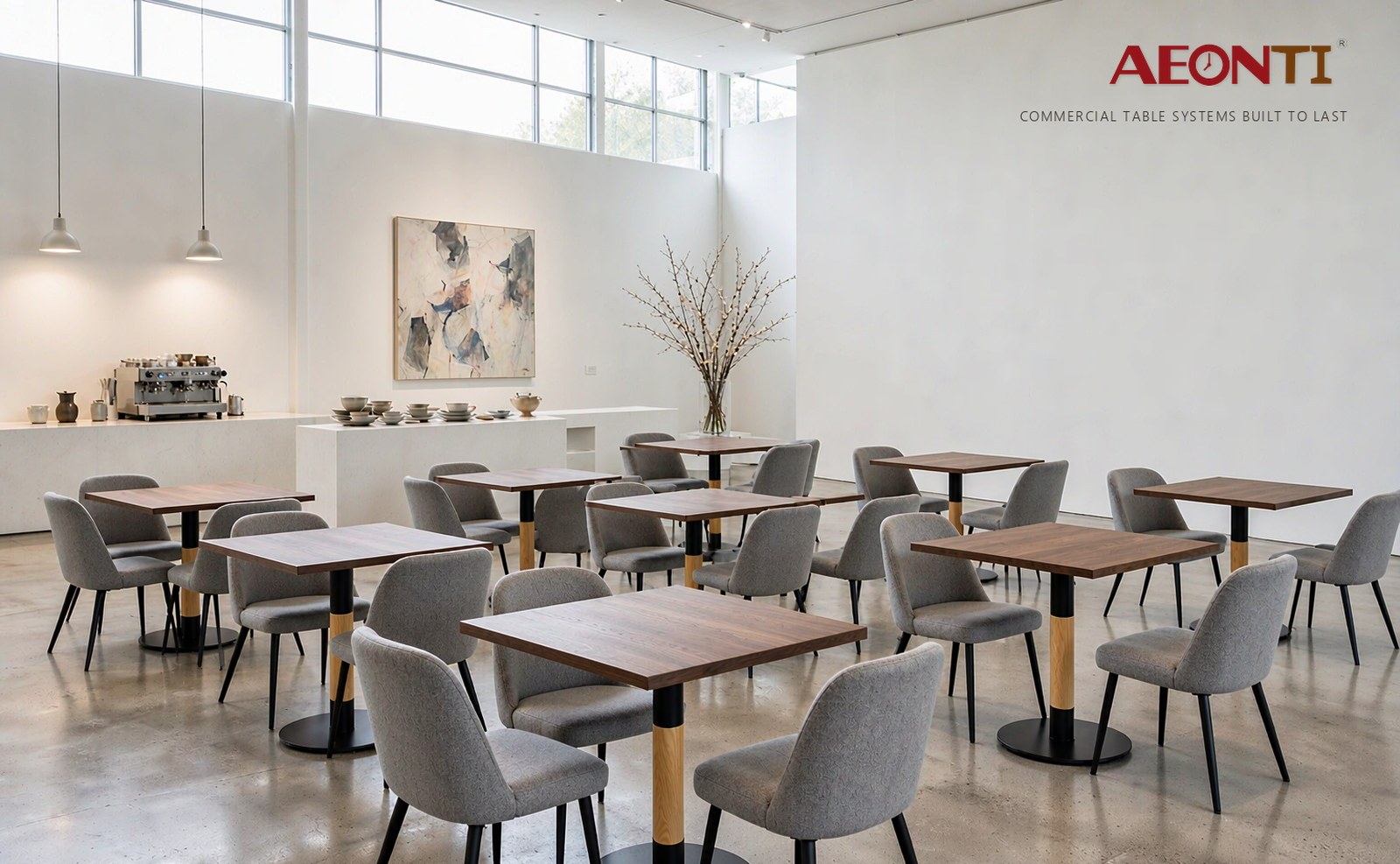
Trend Five · Signal: structural
Mixed materials will become the choice of more buyers
The 2027 market will probably not announce that iron is in and stainless steel is out. The realistic version is quieter: materials get re-assigned to the scenario where their cost structure makes sense.
Cast iron wins where weight and stability decide the specification. Stainless wins where corrosion and cleaning decide it. Aluminium wins where freight and outdoor exposure decide it. That is why we keep cast iron, stainless steel and aluminium running on the same floor rather than betting on one family.
Which means the buyer’s real question is not “which material is best?” but “which material is best for this customer’s building?” The matrix below is the version to keep next to a quotation.
| Use scenario | Material to prioritise | Why it wins there |
|---|---|---|
| Indoor restaurant | Iron | Weight per set holds an 800 mm top still under trolley traffic |
| Premium dining | Stainless steel | Brushed or gold finishes carry a premium read and wipe clean |
| Outdoor dining | Aluminium | Low corrosion risk and roughly half the freight weight of iron |
| Heavy-duty commercial project | Cast iron / heavy-duty steel | Mass in the foot is the cheapest stabiliser available |
| Custom furniture | Metal + special finish | Finish becomes the brand signature instead of a catalogue option |
| Hotel project | Stainless steel | Consistent finish from lobby to restaurant to banquet |
| High-volume furniture | Cost-efficient iron | Lowest cost per stable set at volume |
This is also why a supplier with a richer product line serves different markets more easily. A range with one material forces every customer into the same answer; a range with three lets the heavy-duty project and the price-led container live under one catalogue.
Trend Six · Signal: strong
A base that adapts to different table tops will be more competitive
This is the problem most buyers overlook until the warehouse is already full of near-duplicates.
Suppose you are a furniture distributor. You sell 600 × 600 mm, 700 × 700 mm and 800 × 800 mm tops, Ø600 mm and Ø700 mm rounds, and a 1200 × 600 mm long top. If every size needs a completely different base, inventory management becomes more and more complicated — nine SKUs where three would do.
The more attractive product in 2027 is therefore not a shape but a platform: one column, one foot, a plate with slotted or multi-pattern holes, and a documented plate map showing which tops are approved on which foot. Our base size guide covers the geometry and the round versus square versus rectangular question; the short rule we use is that foot spread should reach at least 60–65% of the top’s narrowest dimension.
One platform makes buying easier — and it also makes these easier:
- Inventory management
- Product mix
- Replenishment
- SKU planning
- Customer customisation
- Project quotation
For a wholesaler that is not a technical feature. It is a lower cost of managing the product line, and it is the difference between quoting a project in a day and quoting it in a week.
Trend Seven · Signal: emerging
Modular bases may become a new opportunity in commercial furniture
If your customers are restaurants, hotels or commercial projects, you already know the problem: the space is never the same twice.
Today it is a two-top. At the weekend it needs to be a four-top. For an event the same room has to become a six-top or a longer combination. So commercial interiors keep moving toward flexible layouts and modular furniture, and industry trend material shows reconfigurable restaurant layouts getting more attention every year.
That pushes base design toward a different set of requirements: different top sizes, top combinations, quick assembly and disassembly, stable connections, storage efficiency and use across several scenarios.
- Two-top to four-top
- Event combinations
- Quick release
- Stackable storage
- Multi-scenario use
Practically, three mechanical details matter more than the silhouette: a foot profile that lets two bases sit close without the plates colliding, a levelling system that stays adjusted after the table has been dragged, and a top connection that can be released and re-tightened without stripping. Compression fittings and captive nuts are worth the small cost difference — our note on attaching tops to bases walks through the options.
For a furniture supplier this can develop into a product series of its own: one foot, several column heights, one connection, paired with the same commercial dining chairs at every height. The same logic sits behind the bar-height versus dining-height split and the bar and lounge specification guide.
Trend Eight · Signal: strong
Custom bases will not disappear — they may become more important
Many buyers assume custom means expensive, and expensive means only large projects need it. That is not quite how it works.
As restaurants, hotels and furniture brands lean harder on their own visual identity, standard bases stop fully meeting the brief. The change a customer actually needs is usually small: height, foot plate size, tube diameter, mounting plate size, surface treatment, colour, logo, packaging, or the top size the base has to accept.
None of that necessarily means developing a completely different product. The customisation that is really worth paying for is a targeted adjustment on top of a mature structure — a proven column, a proven foot, a documented variable changed.
For a buyer this is faster than developing from zero and far easier to keep under cost control. Nine times out of ten it is enough to make a base feel proprietary.
It matters most to hotel groups and multi-site brands, where the requirement is not a new design but the same design repeated across forty properties with a consistent finish. The engineering work sits in finish control and documentation, not in the shape — which is the boundary we wrote about in when customisation is actually worth the extra cost, and the process behind sketch to container.
The filter
What is worth buying in 2027 is not necessarily the “most popular” base
This is the most important point in the whole article. If you are a wholesaler or a furniture brand purchasing manager, do not begin with “which base will be the most popular in 2027?”
Ask instead: “which base will let me sell to more customers in 2027?” Those are two completely different questions, and they lead to different products.
A base can be beautifully designed and still be a bad purchase. If freight cost per set is too high, packing efficiency too low, MOQ too high, lead time too long, volume production unstable, size options missing, finish inconsistent between batches, or replenishment difficult — it is not a commercial product yet.
Conversely, a genuinely good commercial base satisfies the whole chain at the same time: design, function, production, packing, shipping, sales and replenishment. That is the arithmetic behind what a commercial table base actually costs, and it is why we compare landed cost rather than FOB.
| Check | What it looks like when it fails |
|---|---|
| Freight per set | Above the category average before the container is even booked |
| Packing density | A third of the container leaves empty |
| MOQ | Only works if one large project lands |
| Lead time | Moves by three weeks between orders |
| Tolerance at volume | Cannot hold the same fit at 3,000 units |
| Plate flexibility | No second top size on the same plate |
| Finish consistency | Visible variation between batches |
| Re-order path | Depends on a single mould that may not run again |
A base that is beautiful in a photo and expensive in a container is not a trend. It is a sample.
The short list
If you are planning for 2027, watch these four types
Standing in a furniture buyer’s shoes and building a base range for 2027, this is what we would prioritise. They are not alternatives to each other — together they form a complete commercial base matrix.
Pedestal table bases
For restaurants, cafes, hotels and small commercial projects. The volume product: one column, one detail, three finishes, round or square tops on the same plate.
Cross bases
Classic, stable and widely applicable — the shape that suits wholesale and distribution channels because it sells in every market.
Heavy-duty commercial bases
For restaurants, hotels and high-frequency commercial environments, where replacement cost matters more than unit price.
Customisable table bases
For project buying, furniture brands and customers who need special sizes, colours and structures on a proven platform.
Before the PO
Seven questions a buyer should put to a supplier in advance
If you have started looking for a 2027 supplier, put these in the first email. They cost nothing to ask and they tell you more than any catalogue page.
- Which base structures do you actually produce?A list of structures, not a list of product names.
- Which table top sizes can each base match?A plate map is the fastest proof of engineering discipline.
- Do you support OEM and ODM?Follow up with: show me a project that went from drawing to container.
- Can you customise height, foot plate, mounting plate and surface finish?Ask whether each variable can change independently.
- What is the production cycle for a large order?Ask for the number at 3,000 sets, not at sample quantity.
- How is the base packed, and roughly how many fit in a 40HQ?Packing is a cost line. Treat it like one.
- If my order grows from 500 to 3,000 sets, can you hold the same quality and the same lead time?Finish, tolerance and delivery should all be in the answer.
If a supplier can only answer “Yes, we can customise” and cannot go on to describe production, packing, quality control and delivery capability, you probably need to keep comparing. The quality verification checklist, the manufacturer versus supplier explainer and the wholesale FAQ cover the rest of the standard questions.
Closing note
The opportunity in 2027 is not only about what to buy. It is about what to plan for in advance.
The 2027 commercial furniture market will most likely not be dominated by one single base. What is worth watching is where several trends cross: better use of space, stronger design identity, higher commercial durability, a more flexible product mix and easier customisation.
For wholesalers and brand buyers, planning those directions early is worth more than buying once an obvious trend has already appeared on the market. And for restaurants, hotels, cafes and commercial projects, the base should no longer be seen as a part under the table. It decides stability, the experience of the space, the visual result — and it influences what the finished product can be sold for.
Looking for table bases for your 2027 range?
Send the specification. We will send back the base, the plate and the packing plan.
If you are sourcing metal, stainless steel, iron, aluminium, cast iron, heavy-duty commercial or custom table bases, send us your top size, planned quantity, use scenario and target finish. AEONTI will match the right base structure to your project and come back with product recommendations, customisation options and a bulk quotation — in one reply, not five.
- Metal table bases
- Stainless steel bases
- Iron bases
- Aluminium bases
- Cast iron bases
- Heavy-duty bases
- Custom bases
Do not wait until the 2027 market has already caught on before you start looking for a supplier. If you are planning your next batch of products, now is a good time to discuss your next table base.
2027 enquiry sheet
Send us your table specifications and sourcing requirements.
Related reading
2026 restaurant furniture trends Custom commercial bases Reducing landed cost Levelling feet versus shims Hotel and resort bases Metal table base manufacturer
AEONTI — Commercial table systems built to last. Table bases, table tops and chairs for restaurants, hotels and cafes. Trend directions in this article are planning references for range development, not quotations; confirm capacity, MOQ and lead time against your own specification.