Who Is the Most Popular Chinese Table Base Manufacturer for the U.S. Market?
- Share
- publisher
- AEONTI
- Issue Time
- Nov 11,2026
Summary
Which Chinese table base manufacturers do U.S. buyers shortlist in 2026? This guide compares three suppliers - JIKE, XUNDA and AEONTI - then runs the total cost of ownership math behind a cheap table base ($25.00 vs $27.00 becomes $33.95 vs $33.09 per usable set), a material selection matrix for cast iron, stainless steel, aluminium and iron bases, five sourcing mistakes to avoid, and the eight-line RFQ that returns a real supply plan instead of a number.
I f you are sourcing table bases, metal table bases or restaurant table bases for the U.S. market, you have probably noticed the same thing every buyer notices: the category is enormous, the catalogs look identical, and almost nobody publishes the information you actually need to make a decision. Chinese manufacturers now sit at the centre of commercial furniture supply for American distributors, restaurant groups, hospitality buyers and furniture brands. Public B2B platforms list thousands of suppliers offering a cast iron table base, a stainless column, or a stamped steel foot. The number of suppliers is not the problem. The problem is that only a fraction of them can hold a specification steady across ten shipments. So the useful question is not “who is the cheapest table base factory in China”. It is: which supplier matches the way you buy? A wholesaler building a 40-SKU catalog, a contractor furnishing a 12-location restaurant rollout, and a brand owner developing one signature table need three different things from the same factory floor. Below are the three names that U.S. buyers shortlist most often, followed by the cost math that usually changes the decision — and the material, packaging and loading questions that separate a clean program from a year of claims. Before price is even discussed, a commercial-grade supplier should be able to answer all eight of these without a follow-up email: If your requirement is narrow and specific — we need a factory that only does metal table bases and table bases — JIKE is the name that comes up first. Founded in 2002 with headquarters in Panyu, Guangzhou and a production site in Lechang, Guangdong, the company publishes a Lechang plant of more than 40,000 m² and a workforce of over 300. The detail that matters for buyers is focus. This is not a dining-table company that added a table base line as an afterthought. The catalog stays concentrated on cast iron table bases, stainless steel table bases, aluminium table bases, electroplated table bases, indoor and outdoor table bases, and table bases as a category. That concentration is exactly what a wholesaler wants when the brief is “give me depth in one product family”. One factory, one material logic, one finish standard, one set of loading calculations — repeated across forty SKUs. Because the most expensive moment in wholesale is not the first order. It is the third order, when your customer asks for a variation your supplier cannot make — and you have to open a second supply chain to keep the account. A restaurant furniture distributor might need a cast iron table base for a traditional dining room, a stainless steel table base for a modern concept, an aluminium table base for a patio, and an electroplated base for a decorative project — all within one season, all to the same quality expectation. If those four come from four factories, you inherit four sets of tolerances, four packing standards, four inspection routines and four claim conversations. Depth inside one category is what prevents that. Where JIKE competes on category depth, XUNDA competes on institutional memory. The company has been manufacturing furniture hardware for a long time, operates from Foshan, and covers casters, furniture components and table bases, alongside seating hardware. Its published markets include North America, South America, Eastern Europe, Southeast Asia, Oceania and the Middle East. That breadth matters because table bases are a hardware problem before they are a design problem. A factory that has spent decades on sofa legs and casters understands thread standards, plating thickness, weld penetration and the small tolerance stack-up that decides whether a base sits flat on a real restaurant floor. Because commercial furniture purchasing is nothing like retail purchasing. A U.S. distributor may buy several hundred — or several thousand — units in one go, and the line item that decides profit is rarely the fifty cents of unit price. It is this: is shipment two identical to shipment one? If the first batch arrives with a good black finish, stable welds, accurate mounting holes and intact cartons — and the second batch arrives with colour shift, inconsistent weld beads, offset screw holes and crushed packaging — the saving on the invoice is gone, and it is gone in after-sales labour, replacement freight and a customer conversation you cannot win. Third place here is not a size ranking. If you only need one standard table base, there are excellent single-product factories in China — including the two above. But when your brief shifts from “I need to buy table bases” to “I need to develop a complete commercial dining table”, the selection logic changes, because the cost you are managing is no longer the unit price. It is coordination. AEONTI works from the Foshan furniture cluster and covers table bases, commercial table tops and complete dining tables, with matching chairs available in the same program. Roughly 8,000 m² of manufacturing, export to more than 60 countries, and a factory showroom built so buyers can compare structures, materials and finishes in one visit. A distributor developing a new restaurant table usually starts with a clean split: Every unit price looks low. Then the buyer inherits the work nobody quoted: dimension matching between base and top, mounting hole alignment, packing design that fits both, colour and finish coordination, transit scheduling, and final assembly instructions for the end customer. One consolidated supplier does not always win on line-item price. It wins on the number of problems that never reach your inbox — and on how fast a sample can be re-cut when the client changes the top from 700 mm to 800 mm. Two quotes land on the same day. Supplier A offers $25.00 per table base. Supplier B offers $27.00. Most buyers stop there and pick A. Then the container is booked, the cartons arrive, and the real number appears. Here is the same comparison carried through eight cost factors, using a 40HQ shipment of 1,000 sets as the frame: The supplier quoting $2.00 more per unit lands $0.86 cheaper per usable set — before a single claim email is answered. Scale that across 5,000 sets a year and the “cheap” option costs about $4,300 more, plus the labour of managing it. This is why mature U.S. buyers have moved from FOB comparison to total cost of ownership. It is also why the heavy-duty table base range and the commercial table base program are quoted with packing, loading quantity and QC scope attached — a price without those three is not a price, it is a starting point for renegotiation. If you are adding a table base line for the U.S. market, these are the four that absorb the most commercial demand — and where a specification conversation saves the most money later. The reference standard for perceived stability. Visual weight, low centre of gravity, and a footprint that stays planted in a high-traffic dining room. Where the guest sees the base. 304-grade tube, controlled weld dressing and a finish that has to look identical eighteen months later. Weight is the specification. For rooftop, patio and reconfigurable dining, a base that staff can move without a two-person lift changes the operation. The SKU engine of a wholesale catalog. One structure, many finishes — the fastest route from four products to forty without new tooling. Every one of these can be paired with a top from the same program — sintered stone, marble, wooden or HPL — so the base, top and seating arrive with one set of dimensions, one finish standard and one freight plan. You can also configure a full table online and preview the combination before requesting a quote. A base that costs $1 less is not a project that costs $1 less. Product, packaging, freight, damage, QC and after-sales all sit in the same number — and three of those six are invisible on a quotation. A studio image cannot tell you the steel gauge, the weld quality, the mounting plate thickness or the packing method. Move the conversation from “looks right” to documented QC scope before the PO is issued. Table bases feel indestructible. Six weeks in a container proves otherwise: scratches, chipped powder coat, bent components, collapsed cartons. Forty damaged sets in one shipment costs more than the entire saving that created it. Same 1,000 sets, different answer. One factory packs 620 sets into a 40HQ, another packs 760 — and the ocean freight per set moves by more than a dollar. Ask for carton size, sets per carton, CBM, gross and net weight, and loading quantity per 20GP and 40HQ at quotation stage. “I need 500 table bases” produces a price. It does not produce the right product. Indoor or outdoor, tile or carpet, 700 mm or 900 mm top, matt black or brushed gold — every one of those changes the recommendation, and none of them is in a one-line enquiry. There is no permanent answer to “who is the most popular Chinese table base manufacturer” — only an answer that matches your buying model. Use the matrix below to narrow it in one pass: The supplier that fits your model is the only supplier worth a long-term agreement. Everything else is a transaction that will need replacing. The quality of the quote you receive is decided before the supplier replies. Send these eight items and the answer comes back as a supply plan instead of a number: A workable enquiry reads like this — copy it, adjust the numbers, send it: The more complete the brief, the closer the answer gets to a product you can actually ship. A supplier working from a full spec will tell you which structure suits the top weight, which material suits the environment, and how to pack so the container carries more — the three things a one-line enquiry never surfaces. In commercial furniture, “table base” describes the complete support structure — column or columns, spider or mounting plate, foot assembly and levelling glides. Buying a base means buying a rated component, not a loose support. For restaurant and hotel projects the specification is almost always written as a table base, because load rating, plate size and levelling are part of the component, not an accessory to it. For standard commercial table base models, MOQ typically starts at 100 sets, with better pricing from 300–500 sets. Custom structures developed from your drawing usually carry a higher first-order quantity because tooling and sampling are absorbed into the run. Standard production runs are commonly 25–30 days after deposit and drawing approval. Ocean transit to the U.S. West Coast is roughly 18–25 days, and to the East Coast 30–40 days depending on port and routing. Add sampling time if the specification is new. Yes — and this is where a consolidated program pays for itself. Sourcing all three together removes dimension mismatches, separates no packing standards, and puts one team behind fit, finish and freight. AEONTI runs table bases, table tops, complete tables and chairs in one program. Ask for a pre-production sample in the production finish, a colour chip approved against your reference, and the QC checklist used at each stage. A seven-stage inspection process — incoming material, cutting, welding, polishing, coating, assembly and packing — is the minimum standard for commercial-grade table bases. Sometimes the best table base supplier is not the one with the lowest price — it is the one that understands what you are trying to build. Start the comparison with one specific model, and let the specification do the deciding. Tell us the top size, the quantity and the venue. We will come back with the base that suits the load, the finish that suits the room, and a packing plan that keeps freight per set down. Drawing, sample photo, or an existing model — plus top size, quantity, finish and destination port. Recommended structure and material, load rating, finish options, FOB price, MOQ, lead time and loading quantity. Pre-production sample in the production finish, colour chip approval, then a 7-stage QC run before packing. Prefer email? Send your spec to our sourcing desk and reference this guide — request a table base quotation or browse the full commercial table base program first.
Eight things a U.S.-ready table base supplier must answer
JIKE — the specialist table base and table base system maker
Why a deep single-category range still wins in the U.S.
XUNDA — the long furniture hardware history
Why “old supplier” still sells in the U.S. market
AEONTI — for buyers sourcing table base, top and complete table together
The hidden cost of a four-supplier table
The price you see is not the cost you pay
Total cost of ownership — 1,000 table bases, 40HQ
Illustrative model · USD
Cost factor
Supplier A — headline $25.00
Supplier B — headline $27.00
Quoted unit price (FOB) $25.00 $27.00 Export packaging Single-wall carton, minimal foam Double-wall carton, moulded foam, corner guards Loading efficiency 620 sets / 40HQ 760 sets / 40HQ Freight per set $6.77 $5.53 Transit damage rate 3.0% 0.8% Replacement + claim handling $1.20 / set $0.30 / set Batch-to-batch finish variance Visible colour shift Colour chip approved per batch OEM / drawing development Limited In-house engineering
Effective cost per usable set on site
$33.95
$33.09
Four table base categories worth putting on a 2026 program
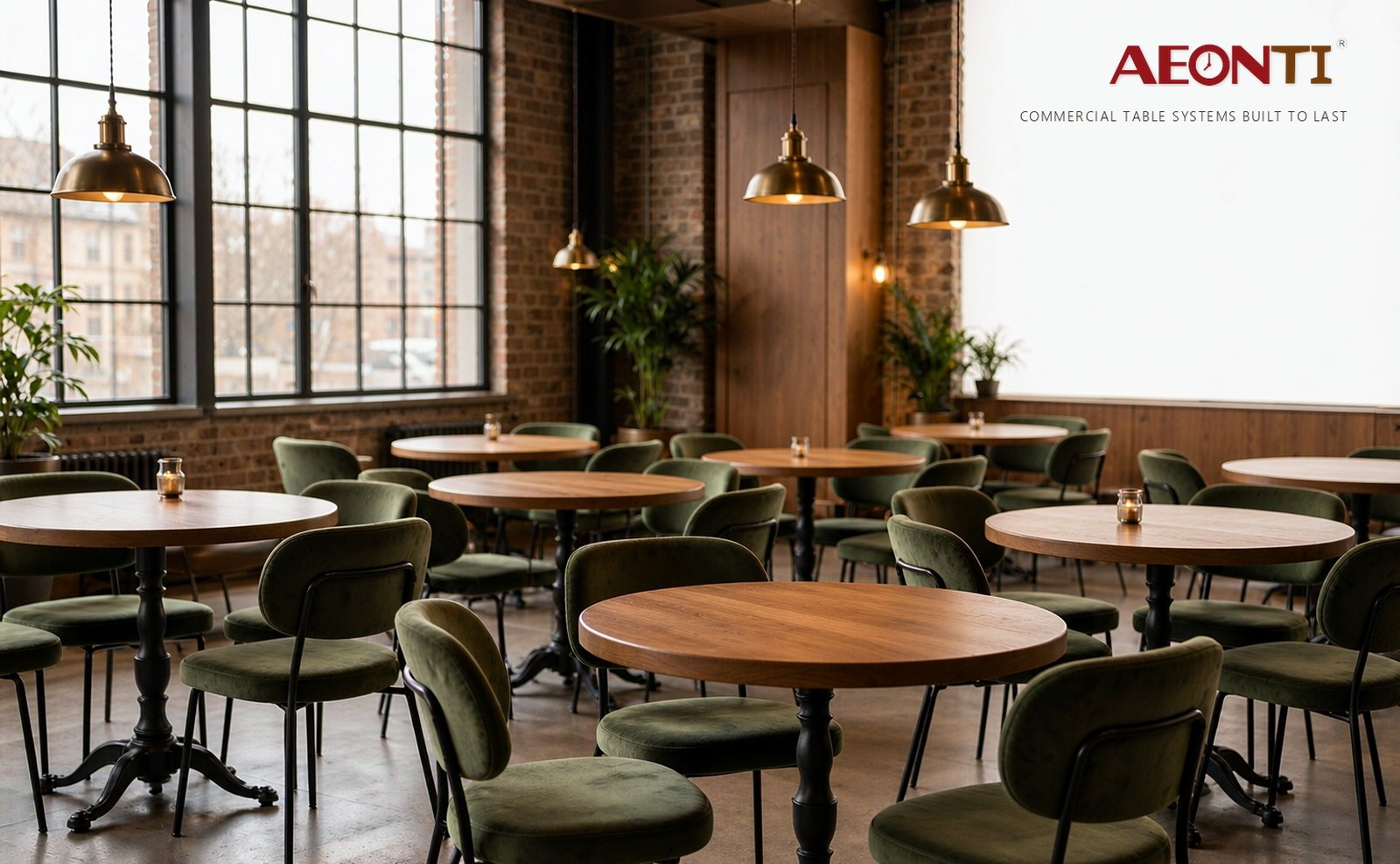
Cast Iron Table Bases
View cast iron range →
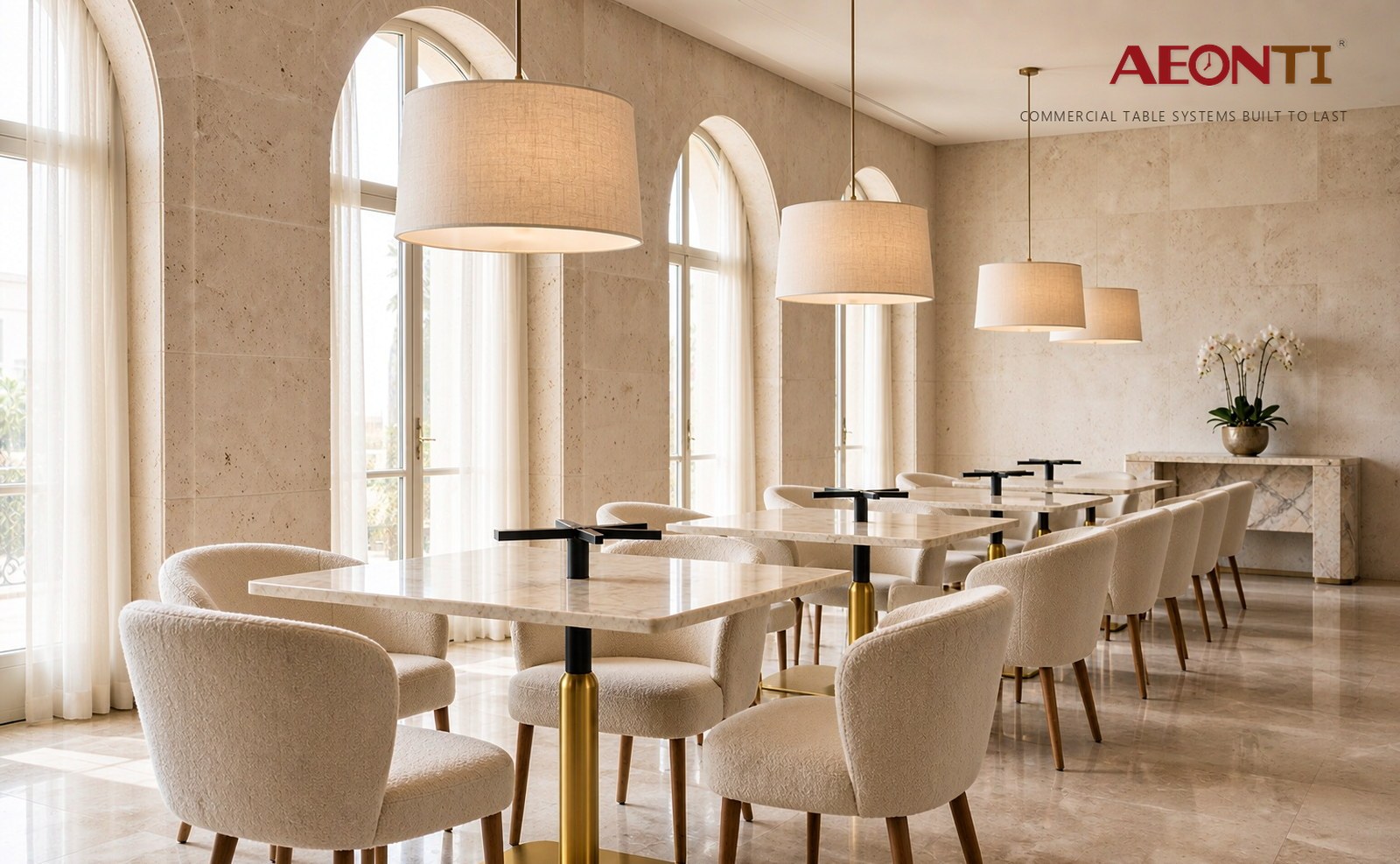
Stainless Steel Table Bases
View stainless range →
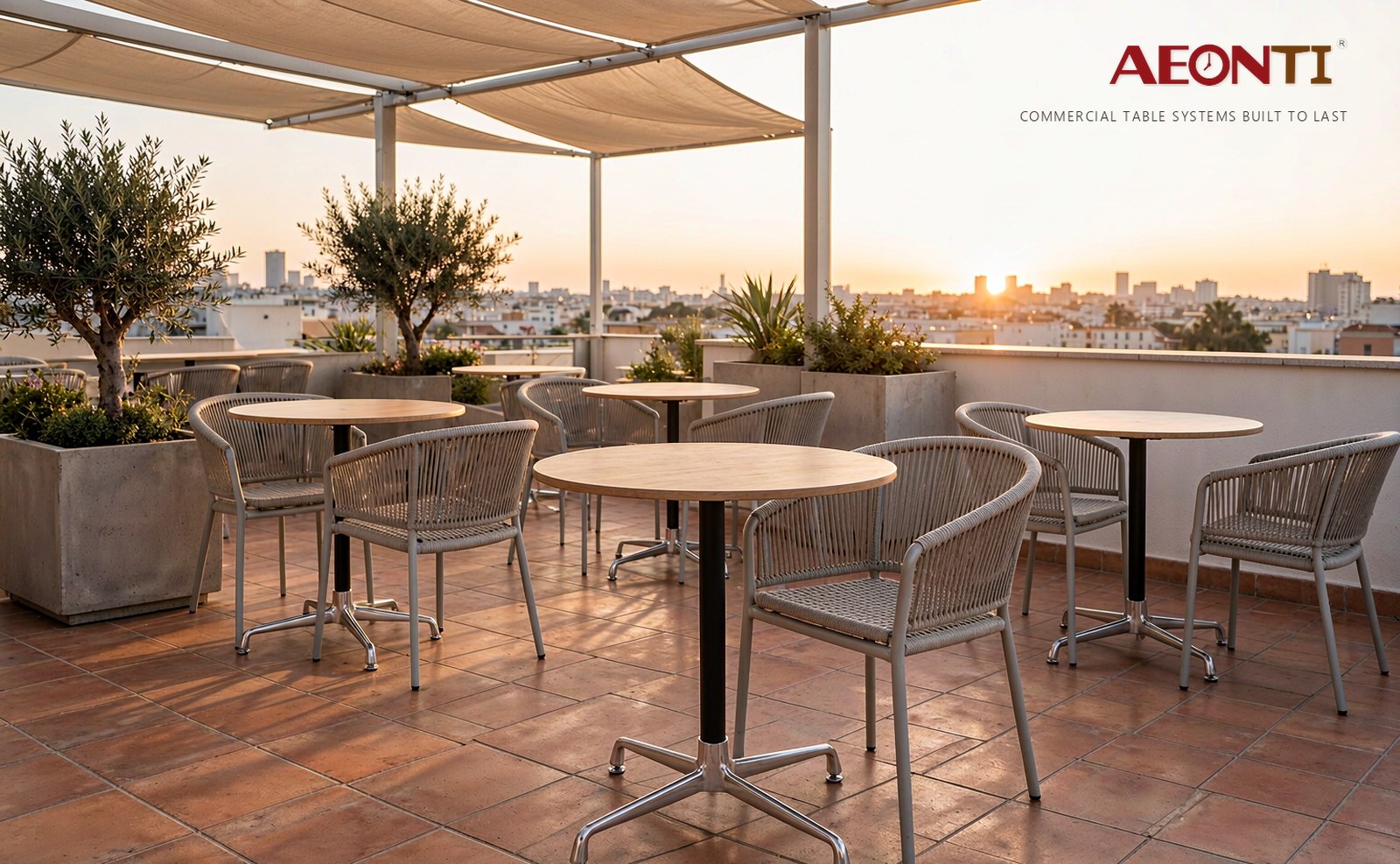
Aluminium Table Bases
View aluminium range →
Iron & Powder-Coated Table Bases
View iron range →
Material selection matrix
Match the base to the venue, not to the photo
Base type Load per base Best-fit venues What to verify before ordering
Cast iron table base
120–180 kg
Restaurants, diners, banqueting
Cast weight, foot flatness, mounting plate thickness
Stainless steel table base
150–200+ kg
Hotels, fine dining, coastal, poolside
304 grade confirmation, wall thickness, weld dressing
Aluminium table base
100–150 kg
Patios, rooftops, terraces, resorts
Wall thickness, plate size for wind load, coating adhesion
Iron / stamped iron base
100–150 kg
Cafés, bistros, co-working, retail
Weld consistency, powder adhesion, colour chip approval
Custom table base
Project-specific
Brand programs, contract furniture
Drawing review, tooling cost, sampling lead time
Five mistakes U.S. buyers make when sourcing table bases
Comparing FOB price only
Buying from photographs
Ignoring packaging
Not confirming loading quantity up front
Never stating the end-use environment
So which supplier should you actually choose?
Sourcing need → where to look
Filter by requirement, not by reputation
If your requirement is… Look at… A complete professional table base product line JIKE Long furniture hardware manufacturing history XUNDA Table base + table top + complete table from one team AEONTI Depth in the cast iron family Cast iron table base specialists Stainless steel for hospitality projects Stainless steel table base range Outdoor and patio programs Aluminium table base suppliers OEM / ODM development from your drawing Manufacturers with in-house engineering Restaurant and hotel project supply Commercial furniture supply chains High-volume wholesale Capacity, packaging and loading efficiency — in that order Furniture wholesale and distribution Wholesale table base programs Contract and design-firm specification Contract-grade table bases Stop asking “how much?” — send these eight lines instead
What a professional reply should include
We are sourcing table bases for restaurant furniture in the U.S. market.
Quantity: 500 sets // Table top: 700 × 700 mm
Use: indoor // Finish: matt black
Please quote FOB price, packing details, loading quantity per 40HQ and lead time.
// Add: destination port, sample requirement, target ship date
Questions U.S. buyers ask before the first order
What exactly is included in a commercial table base?
What MOQ should a U.S. distributor expect?
How long does production and shipping take?
Can one factory supply the base, the top and the chairs?
How do I verify quality before a bulk order?
Send one specification. Get a table base program back.
Send your spec
Get a matched proposal
Sample, approve, produce
What to send us
What you get back