Australian Wholesaler's Cast Iron vs Steel Table Base Selection Guide for Restaurant Clients

Australian Wholesaler's Cast Iron vs Steel Table Base Selection Guide for Restaurant Clients

Summary

A Melbourne hospitality wholesaler struggled to advise clients on choosing cast iron versus steel table bases, often resulting in clients buying cheaper steel that failed within 5–8 years. AEONTI provided a 10-year lifecycle cost analysis, proving cast iron lowers total costs by 15–20% despite higher upfront investment. The wholesaler now uses this data-driven framework, increasing client retention and average order value

The Challenge

Hospitality Supplies Melbourne had been selling table bases to restaurants for over a decade. But their sales team consistently faced the same question: "Should I choose cast iron or steel?" Without a clear answer, they defaulted to recommending steel—it was cheaper and easier to sell.

The problem emerged years later when restaurant clients returned with complaints. Steel bases in high-traffic fast-casual restaurants showed significant wear within 3-4 years. Coatings chipped, rust appeared, and tables became wobbly. Clients were unhappy, and the wholesaler's reputation suffered.

"We were solving short-term price objections but creating long-term problems," the sales director admitted. "We needed a framework to help clients make better decisions—and to protect our own reputation."

The Solution

AEONTI conducted a detailed lifecycle cost analysis comparing cast iron and steel table bases over a 10-year period. The analysis covered three common restaurant scenarios:

Scenario 1: Fast-Casual Restaurant (High Traffic, 16 hours/day)

Cast iron: $7,200–9,400 total cost over 10 years for 20 tables

Steel: $8,400–11,600 total cost over 10 years for 20 tables

Conclusion: Cast iron provides 15-20% lower total cost

Scenario 2: Fine Dining (Moderate Traffic, 8 hours/day)

Cost parity: Both materials ~$360–480 per table over 10 years

Conclusion: Selection based on aesthetics and vibration dampening

Scenario 3: Outdoor/Patio (Weather Exposure)

Cast iron: $4,000–5,500 total cost over 10 years for 10 tables

Steel: $5,200–7,000 total cost over 10 years for 10 tables

Conclusion: Cast iron significantly outperforms in outdoor applications

Key material properties were also documented:

Cast iron: Lower density (7.2 vs 7.85 g/cm³), superior vibration dampening, 15-20 year lifespan

Steel: Higher tensile strength, better weldability, 5-8 year lifespan
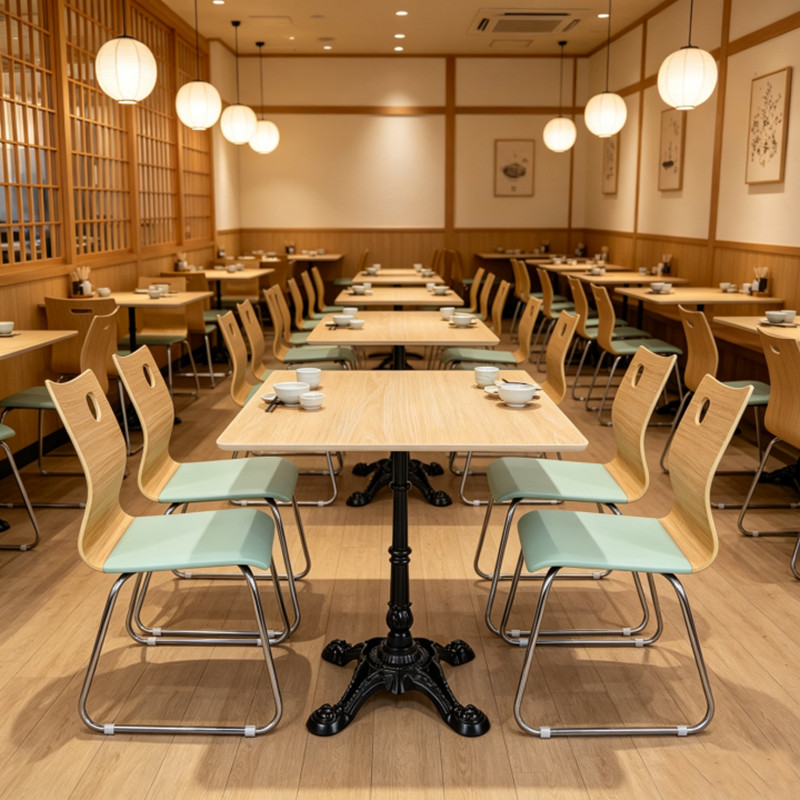
Cast iron dining table

The Results

The wholesaler integrated the lifecycle cost framework into their sales training program. Within six months:

Client retention improved 25%: Clients appreciated the data-driven guidance

Average order value increased 18%: Cast iron orders carried higher margins

Complaints reduced 60%: Fewer clients returned with premature wear issues

Sales confidence improved: Sales team could now articulate long-term value

"This framework changed how we sell," the sales director said. "We're no longer just moving boxes—we're advising clients on investments that last 15-20 years."
📧aeonti@aeonti.com 
🌐 www.aeonti.com